In my opinion out of the eleven choices given it contained five severe violations that breach legal boundaries and potentially endanger individuals, compromising their privacy and security. Firstly, sharing personal data, such as passwords, addresses, or photos of others without consent, constitutes a severe breach of privacy. Secondly, using unofficial streaming services to access copyrighted material without authorization undermines content creators’ rights and exposes users to legal liabilities. Thirdly, recording calls without consent violates individuals’ privacy rights and may have legal ramifications. Fourthly, engaging in identity fraud or falsifying personal information online violates terms of service and poses significant risks. Finally, collecting information about minors without proper consent violates laws such as the Children’s Online Protection Act, raising severe ethical and legal concerns regarding the protection of minors’ online privacy and safety. These offenses are considered severe because of their potential to cause harm, infringe upon individuals’ rights, and contravene established legal frameworks that protect online users and their data.
Journal 13
In this journal article, it will delve deeper into the article given and show the role played by VDPs and Bug Bounty Programs in improving cybersecurity. Despite some controversy at their introduction, both initiatives have seen a significant uptake in recent years due to their success in uncovering previously unknown cybersecurity vulnerabilities. The empirical contribution consists of analyzing the determinants of the effectiveness of Bug Bounty Programs, using inquiry-driven econometric methods such as robust regression models and instrumental variable strategies to establish causality and address endogeneity concerns that could cloud the results of ordinary regression. They re-examine the controversial conclusion of the ‘price insensitivity’ of hackers, source-code type hypotheses explaining the differences in vulnerability reporting across industries, and the effectiveness of BBP as tools in cybersecurity risk management. They discuss the sources of bias in the results, highlighting some policy implications for practitioners and researchers to help them strengthen organizational cybersecurity defenses.
Journal 12
Market Failure theory is a framework that examines situations where markets cannot allocate resources efficiently. Data breaches can be seen as a form of market failure. The failure to adequately secure customer data can lead to negative externalities such as potential identity theft or fraud. This means that customers may incur costs due to the breach not accounted for in the market transactions.
Cost-benefit analysis is a theory that customers apply when purchasing online platforms. A data breach introduces new costs that customers did not initially consider. This theory highlights how customers may reassess the website’s benefits against the possible risks following the breach.
Social Exchange Theory examines the social relationships between individuals involved in transactions and their associated costs and benefits. Customers engaged in transactions with the website expect benefits like purchasing goods while minimizing risks. However, the breach disrupts this exchange by exposing customers to the risk of identity theft or fraud, leading to a breakdown in trust between the customers and the website.
Conflict Theory emphasizes power imbalances and conflicts of interest in social interactions. In the breach incident, a clear power imbalance exists between the website’s platform provider, who controls customer data, and the customers themselves. The breach highlights the conflict between the provider’s negligence in safeguarding customer data and the customers’ expectation of privacy and security. This breach exacerbates tensions between individuals and institutions regarding confidentiality and data security, reflecting broader societal conflicts over control and ownership of personal information.
All of these relate to the letter due to them all surrounding conflicts that have to do with losing something such as money.
Journal 10
When it comes to social cybersecurity, is a critical aspect of modern warfare, as it focuses on understanding how human behavior intersects with technology. It involves manipulating human behavior through technology to achieve strategic goals, this manipulation then affects the protection of information systems. An example of this is the Russian propaganda machine as it serves as a notable example of leveraging information warfare tactics to weaken nations.
Another thing is about bots which are powered by artificial intelligence. Bots play a significant role in these operations by spreading misinformation and amplifying social divisions. To combat these threats, military leaders must adopt quick policies that enable ethical maneuvering within the information domain while safeguarding individual privacy. To conclude, social cybersecurity is about understanding and defending against the manipulation of human behavior and societal structures in this digital age.
Journal 11
With this journal it goes into a video that reviews information into what a
cyber security analyst is. Analysts branch off into many different things
because they are the first responders to any cyber related incident. When it
comes to social attacks on the network, they will be the first to deal with it.
Some of the social attacks mentioned are ones I have brought up earlier and it’s
called Phishing. Phishing is a main attack that needs to be responded to
quickly and it occurs in mostly emails.
Another thing about analyst jobs is you need to be updated with all the
newest cyber security trends and updates. That means you need to surf social
media and keep up with the news in case any attacks are about to be listed.
That adds on to the social aspect of cyber security analysts.
Journal 9
I read Tobi-Goldfus-Social-Media-Disorder-Scale and watched the video
correlated with it. Now going through it I scored 2 out of 9, only because I
look at social media when I’m upset or bored and to help clear the mind. I know
there are times where there is work and play, and taking pictures of obviously
data sensitive things is bad. There are places in companies that allow you to
take phone calls or breaks such as break rooms, bathrooms, outside areas, and
private meeting rooms. Wait till you’re able to enter these places before you start
giving out data that may or may not be sensitive.
The scale is also very aggravating to read as to why, it’s because who would
you be so deep into social media that they can’t go without it for as hour. I
guess depending on your circumstances and your past it’s understandable why
they would cling to social media as a way to get attention, but as mentioned
there is a time and place for that. Because when you post of social media you don’t
know who is looking at your stuff, and like that video indicated, it can be a
hacker trying to break in.
Journal 8
When it comes to social media and it’s impact on us as humans when it comes to cyber security its actually quite prominente. Media is everywhere no matter if you are trying to avoid it or not, its all around us while were driving, in stores, or even going into nature.
The main form of media that was talked about in the video we were presented to watch, focused on movies with scenes that focused on hackers or cyber security related things. More people watch movies and shows over actually looking up how to help when you are attacked by a virus or hacker. This of course makes people believe that what happens in movies is what truly goes down in real life. Most stuff that they do in movies makes it seem easier then it actually is, such as pulling out gadgets that instantly figure out your password.
There are times when in movies, but mostly TV shows they are very realistic about there approach. TV shows have more time to dwell in making realistic measures cause there series will always be longer then a hour to 2 hour movie. In the video she points out a few realistic things and I noticed it was with TV shows more then a movie. But to finalize, media is a main source of our information because its everywhere.
Journal 7
In this journal I made 3 memes that I believe I could centralize the most around human center cyber security.
Meme #1

- This goes with Human Based security as one thing humans do security wise is sift through the spam mail then trash what’s unneeded. Doing this often can keep you from unnecessary phishing that’s found in emails.
Meme #2
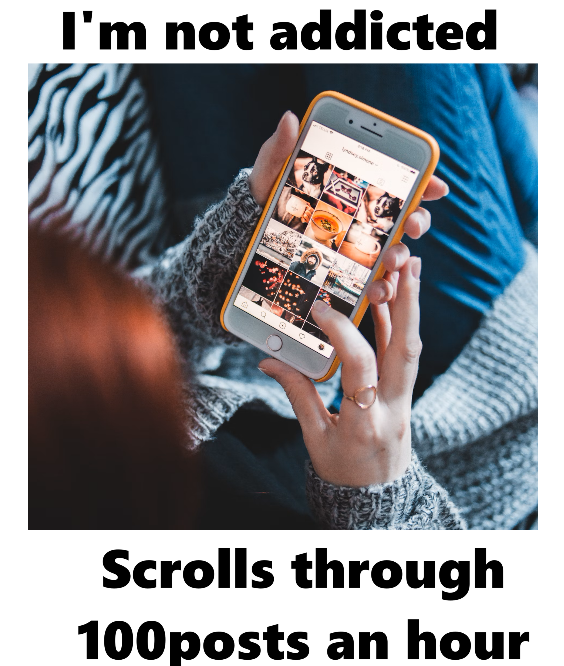
- Social media is a big thing when it comes to human security, since social media is free to everyone with little to know filter to stop people from stealing your personal info. It’s your job condese time spent on social media to better protect yourself from harmful posts or users.
Meme #3

Computers don’t always follow what you want it to do, sometimes in that case the computer is not up to date or has been compromised. That’s a main security risk for humans to keep up with.
Journal 6
Victoria Sanderson
2/14/2024
For this Journal it revolves around how to tell between fake vs real sites while surfing the web. Of course while you may be looking for a certain site on the web you come across a look a like that’s not actually the real thing. I remember as a kid looking for mods to mod my games and you can come across a site that looks slightly different then what you are used too. There are several misspellings, the name is wrong, even the URL is red where the log should be.
Fake sites:
- Zorasoul.com – fake clothes site, used to steal credit card information thinking your actually buying clothes from the store
- Cursedforges.com – Fake modding site, the real site is named “curseforge.com”.
- BedBathClose.com – Impersonating Bed, Bath, and Beyond after they were closing, thinking they can buy stuff here and get there closing deals. The site looked fake and the deals were to good to be true.
Real sites:
- macys.com – acutal well made site, site can find nearby stores and show the actual sales going on.
- curseforge.com – the real modding site with reviews and correct spelling.
- bedbathandbeyong.com – the actual site that bring you to the store page for the sales.
Journal 5
The journal reviews over the individual motives people have when it comes to committing crimes. each motive consists of entertainment, political, revenge, boredom, recognition, money, or multiple of these reasons.
- Multiple reasons – I believe if you have multiple reasons to commit a crime you have a stronger motivation and reasoning then others that might commit the same crime.
- Money – Money can be scarce or maybe the person is greedy, either way money is a big factor.
- revenge – This occurs if something happened that made you want to commit the crime meaning they had reason for what they did.
- entertainment – some people are born with boring lives or have a brain problem that cause them to do this.
- boredom – They just live boring lives and wish to feel excitement, but a stable life is better then no life.
- recognition – This recognition will always make the person look bad meaning why would you want bad recognition.
- politics – why would you commit a crime for a person you never even met?