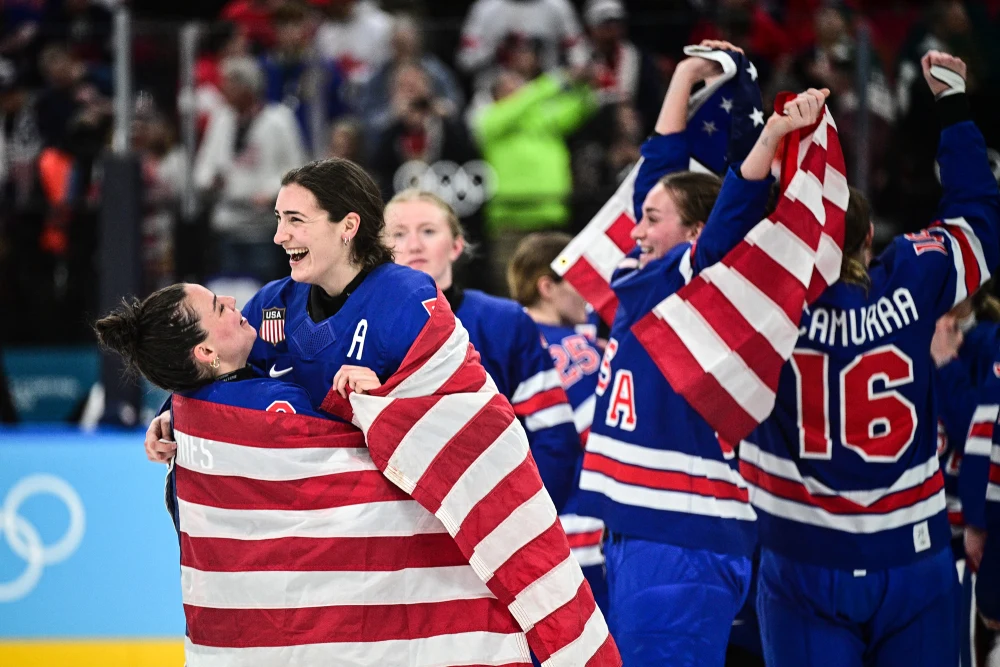
As the final buzzer sounded, the U.S. women’s hockey team rushed the ice sticks raised, gloves thrown, gold medals within reach. It should have been a moment that united fans across the sport. Dominant, relentless, and historic, their performance was everything hockey claims to celebrate.
But as the celebration faded, something else crept in. The online reactions, the media coverage, the subtle dismissals, it all told a different story. One that had nothing to do with skill, and everything to do with who was playing.
For many fans that contrast is hard to ignore, for others, it’s the first glimpse into a deeper issue that has long defined elite men’s hockey; especially within the National Hockey League. Beneath the speed, physicality, and tradition lies a culture that has repeatedly been called out for misogyny, homophobia, and exclusion. And while the sport is beginning to confront those realities, change has been slow, uneven, and resisted.
The reaction to the U.S. women’s success is not an isolated moment, it reflects patterns that researchers and advocates have been documenting for years. Studies on hockey culture point to deeply ingrained gender biases, where women’s achievements are minimized or treated as secondary, regardless of performance. Even at the highest level, women’s hockey is often framed as a lesser version of the men’s game.
That mindset has consequences. It shapes media coverage, influences funding and visibility, and reinforces the idea that hockey at least in its “purest” form belongs to men. The result is a sport where women must constantly prove their legitimacy, even while standing at the top of the podium.
But misogyny is only one piece of the problem.
For years, players and advocates have described men’s hockey as a space where conformity is expected, and difference is quietly pushed aside. Nowhere is that more evident than in conversations around sexuality. Despite the NHL’s global reach and cultural influence, openly gay players remain virtually nonexistent at the top levels of men’s professional hockey.
Former player Brock McGillis has spoken openly about his experiences, describing a culture where silence was often safer than honesty. His story is not just personal it reflects a broader environment where locker room norms, language, and expectations create barriers that extend far beyond the ice. Inclusion campaigns and public statements have emerged in recent years, but critics argue they often fail to address the deeper cultural dynamics that make players feel unsafe being themselves.
This culture of exclusion is not limited to gender or sexuality. Issues of race and diversity continue to shape who feels welcome in hockey and who does not. While the sport has made efforts to broaden its reach, representation at the highest levels remains limited, and incidents of racism both on and off the ice underscore how far there is left to go.
These patterns reveal something more systemic than a few isolated incidents. They point to a version of hockey culture that has long prioritized tradition over transformation, and silence over accountability.
And yet, change is happening just not always where people expect it.
In recent years, the rise of the Professional Women’s Hockey League has offered a different vision of what the sport can be. Built with an emphasis on visibility, investment, and inclusivity, the league has quickly gained traction, drawing fans, media attention, and momentum that women’s hockey has historically been denied. Its growth is not just a success story, it’s a statement.
The PWHL represents more than opportunity; it represents a cultural shift. One where players are celebrated not in spite of who they are, but because of it. One where diversity is not treated as a disruption, but as a strength. And perhaps most importantly, one where the next generation of players can imagine a future in hockey that does not require them to shrink themselves to fit.
There is something powerful about that possibility. Because if hockey’s past has been shaped by exclusion, its future does not have to be.
The contrast between the U.S. women’s gold medal moment and the reaction that followed is more than a snapshot of inequality it’s a reflection of a sport at a crossroads. One path continues to defend tradition, even when it excludes. The other begins to reimagine what hockey can be, who it is for, and whose stories get told.
The game itself has never been the problem, the speed, the skill, the intensity are what draw people in. What happens around the game, however, determines who gets to stay, who gets recognized, and who gets pushed to the margins.
As leagues like the PWHL continue to grow and voices within the sport push for accountability, the gap between hockey’s ideals and its reality is becoming harder to ignore. And for many fans, that tension is no longer something to overlook it’s something to confront.
The question now is whether the culture surrounding the sport will ever allow them to.