Welcome
My name is Corey Guillaume. I am currently attending Old Dominion University where I am currently majoring in cybersecurity and I am currently set to graduate in 2027. Being part of a military family, I’ve lived in a lot of different places. I currently live in Chesapeake, Virginia and graduated from Grassfield High School. My career aspiration is to work in Information Technology.
Personal Narrative Essay
IDS 493: ELECTRONIC PORTFOLIO PROJECT
Starting college was a major adjustment because I had to balance school, work, and
personal responsibilities. My first two semesters were especially challenging as I learned to
manage my time and adapt to different professors’ expectations. I began as a computer science
major but soon realized it was not the right fit, so I switched to cybersecurity, which better
aligned with my interests and career goals. One of my greatest challenges was attempting to pass
pre-calculus. After struggling with math in the past, I had to retake the course and finally passed
it during the spring semester of my sophomore year. Although the class was difficult, the
experience taught me discipline, consistency, and responsibility for my future. Looking back,
these experiences have shaped how I see myself as a college student and as someone preparing
for a career in cybersecurity.
When I first started college at Old Dominion University, I believed I was prepared for the
transition. However, I soon realized that college required a much higher level of independence
than high school. The freedom was greater, but so was the responsibility. No one was constantly
reminding me about assignment due dates, upcoming tests, or how to manage my time, so I had
to learn how to stay organized and hold myself accountable.
One of the hardest parts for me was balancing school and work. Going to work while also
trying to keep up with college assignments made time management difficult. There were times
when I had to decide what needed to be done first and when I could actually sit down and focus.
I also had to get used to the fact that every professor had their own way of teaching and grading.
Some teachers were more straightforward, while others expected students to approach
assignments in a certain way. Learning how different professors operated was something I had to
adjust to.
During my first two semesters, I was basically learning how to be a college student while
already being one. I was still figuring out what study habits worked for me and how much effort
I needed to put into each class. Looking back, those first semesters were important because they
showed me that doing well in college was not only about being smart but also about being
organized, consistent, and willing to put in the work.
Another important part of my first semester was realizing that computer science was not
the right major for me. I originally entered ODU as a computer science major because I was
interested in technology and thought it would be a good career path. However, I realized very
early that the major was not for me. By the end of my first semester, I knew that I needed to
make a change. I eventually switched my major to cybersecurity. This decision was important
because it showed me that changing directions does not necessarily mean that I failed. Instead, it
meant that I learned more about myself. I was still interested in technology, but cybersecurity felt
like a better fit for my interests and the type of work I could see myself doing in the future. I
think this was one of the first major decisions I made in college where I had to be honest with
myself about what I wanted instead of simply sticking with my original plan. McAdams (2001)
explains that people develop their identities through the life stories they create about themselves.
These stories connect different experiences together and give them meaning. When I look back
at changing my major, I do not see it as just switching from one degree to another. It was part of
learning who I was as a college student and what direction I wanted my future to take. My first
semester helped me understand that the path I originally chose was not necessarily the path I
needed to stay on.
The biggest academic obstacle I faced in college was definitely pre-calculus. Math has
never been my strongest subject, and I had already experienced roadblocks with my first required
math course,Math 102, although it was not as difficult for me as pre-calculus ended up being. I
already knew that math could be a challenge for me, but I did not expect pre-calculus to become
such a major roadblock.
When I first took pre-calculus, the material was super complex and difficult for me to
understand and execute. I could look at a problem and understand parts of what I was supposed
to do, but putting everything together was another story. There were times when I felt like I
understood something in class, only to get home and struggle when I tried to do the problems
myself. Not passing the first time was disappointing because I knew I needed the class to
continue moving forward in my degree. Instead of giving up, I took the class again during my
sophomore spring semester. This time, I approached it differently. I reused the notes I had taken
the first time I took the course and spent a lot of time watching youtube videos about the subjects
I was struggling with. Sometimes hearing another person explain the same concept in a different
way made it easier for me to understand. I did not suddenly become great at math, but I became
better at figuring out what I needed to do when I did not understand something. When I finally
passed pre-calculus, I was extremely happy and relieved. It honestly felt like a huge weight had
been lifted off of me. That course had been one of the biggest things standing in my way,
especially because I had already struggled with math prior. Passing it showed me that struggling
with something did not automatically mean I could not overcome it. I just had to find a better
way to approach it and keep working.
My experience with pre-calculus also changed how I viewed failure. Before, having to
retake a class could make me feel like I was falling behind. After passing pre-calculus the second
time, I started to see setbacks differently. Sometimes struggling with something is just part of
learning. The important part is what you do afterward. I had already seen the material once, so
instead of starting completely over mentally, I used what I had learned from my first attempt and
changed my approach.
This is where the idea of “locking in” became important to me. To me, locking in means
becoming disciplined and seriously focused on what I need to accomplish. It means thinking
about my future and realizing that nobody else can do the work for me. I learned this through
both work and school. Since I work while going to school, I cannot always wait until I feel
motivated to complete my assignments. I have to make time for my academics and actually use
that time wisely.
Nguyen (2013) discusses how students can use ePortfolios to reflect on their education,
learning, and identity and create a more connected story between their past, present, and future.
This idea relates to how I look at my own college experience. The individual things I have done
in college might not seem connected at first. Working while going to school, changing my major,
struggling with math, passing precalc, and taking interdisciplinary courses all seem like separate
experiences. However, when I look at them together, they show how I have changed since I first
started college.
My coursework has also helped me develop skills that I believe will be useful in
cybersecurity. Courses such as IDS 300W and IDS 493 helped me understand the value of
interdisciplinary skills. These courses showed me that education is not always about staying
inside one subject. Sometimes the most useful skills come from being able to connect different
areas of knowledge and look at a problem from more than one perspective. That is especially
important to me because cybersecurity is not only about computers and technology. A career in
cybersecurity can require communication, critical thinking, problem-solving, and the ability to
understand different situations. My interdisciplinary coursework has helped me see that the skills
I develop in college can be useful in more ways than I originally expected.
When I think about my college experience so far, I do not think of it as a perfect or easy
journey. I struggled with time management, had to adjust to different professors, changed my
major, and had to retake pre-calculus. At the time, some of these experiences were frustrating.
However, they have become some of the most important parts of my college story. My biggest
lesson has been that progress does not always happen quickly. Sometimes it means taking a class
again, changing your major, finding a different way to learn something, or simply becoming
more disciplined. Passing pre-calculus was especially meaningful because it showed me that I
could overcome something that had been holding me back.
My narrative identity as a college student is still developing. I am someone who started
college unsure of exactly what direction I wanted to take, struggled while adjusting to the
responsibilities of college, and eventually became more focused on my future. I started out
thinking computer science was going to be my path, but I learned that it was not for me and
found a better direction in cybersecurity. I am now working toward a career where I can use my
skills in technology, problem-solving, and critical thinking. I still have more to learn, but I
understand myself better than I did when I first started college. College has taught me that
sometimes the obstacles in front of you become part of the reason you grow. For me, learning to
“lock in” was not just about passing one difficult math class. It was about realizing that my
future depends on the choices and effort I put in today.
References
McAdams, D. P. (2001). The psychology of life stories. Review of General Psychology,
5(2), 100–122. https://www.scribd.com/document/787727335/McAdams-Life-Stories-2001-PDF
Nguyen, C. F. (2013). The ePortfolio as a living portal: A medium for student learning,
identity, and assessment. International Journal of ePortfolio, 3(2), 135–148.
https://files.eric.ed.gov/fulltext/EJ1107805.pdf
Skills and Artifacts: 3 Skillsets and 9 Artifacts
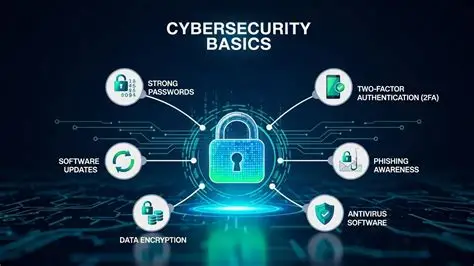
Skill 1: Cybersecurity Basics
Artifacts: Security+ in progress
Security+ preparation notes and practice assessments
Basic threat and vulnerability analysis
Cybersecurity concepts and defensive security exercises
Skill 2: IT Troubleshooting
Artifacts: Windows & Linux Troubleshooting Lab
Documented troubleshooting scenarios
Step-by-step solutions to common system issues
Windows and Linux command-line exercises
Skill 3: IT Python Programming
Artifact: Python Cybersecurity Projects
Python scripts for basic automation
File and system utilities
Small cybersecurity-focused programming projects
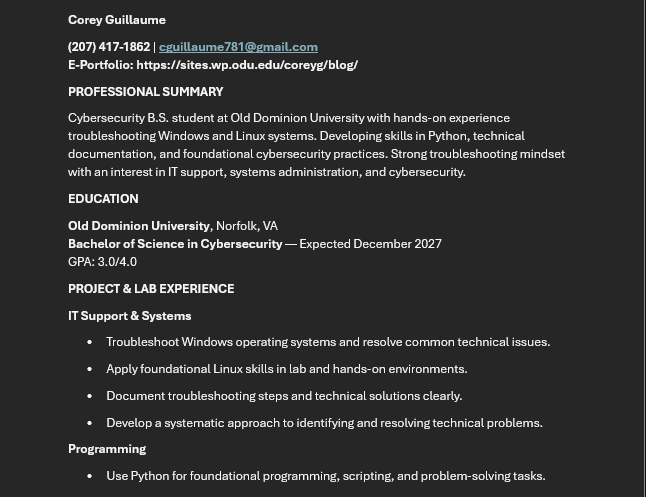
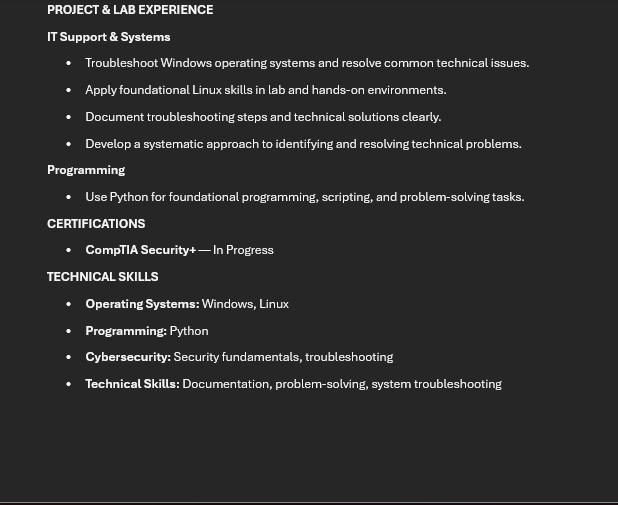
Resume
Writing Assignment One: Job Analysis
Writing Assignment Two: Personal Narrative