
Educational Artifact
Artifact 1
While pursuing my associate degree in the Elementary Education program at Paul D. Camp Community College in Franklin, Virginia. I changed my degree to the leadership program at ODU and joined a study group for an introductory physics course. I found many students struggled with the complex problems and felt overwhelmed. My strategy was to shift my focus from simply getting the correct answers to understanding how the underlying concepts work. Instead of providing direct solutions, I would guide the group through a Socratic method, asking questions that would help lead them to their own conclusions.
To foster a collaborative learning environment, I encourage the students in the group to support and help one another. For example, I would enable them to ask students who understood a particular concept to explain it to the rest of the group. This not only reinforced their own knowledge but also built confidence and fostered peer-to-peer collaboration. My leadership in this group and context was less about being an authority and more about creating a supportive space where everyone felt comfortable sharing their ideas and asking questions. The outcome was that the entire group improved their grades and, more importantly, gained a deeper appreciation for the subject matter.
Artifact 2
Paper from ODU Virginia History Class. Fall 2026
Suffrage in Virginia
I chose the topic of suffrage in Virginia; by the late nineteenth and early twentieth centuries, the United States was profoundly transforming its democracy, and women mobilized across the country to demand constitutional changes that would allow them to vote. Even though the nation wasn’t moving as many imagined, it became radicalized, as shown by dramatic congressional shotgun showdowns, and it first fought for enfranchisement where it played out very differently in the conservative political culture of the American South. Virginia traditionally upheld a social hierarchy and resisted federal interference in politics; the suffrage movement first took root with the founding of the Equal Suffrage League of Virginia (ESLV) in the early 1900s. While it led to reforms such as the Lila Meade Valentine, the league faced many challenges in furthering women’s rights in the Commonwealth of Virginia, especially as the state resisted social change. Equal Suffrage League of Virginia deployed arguments and pressured for the Nineteenth Amendment; the Commonwealth measured its response, and its legislature resisted ratification for decades.
The birth of the ESLV, which means Equal Suffrage League of Virginia, was formed in Richmond in November 1909; it entered the most politically hostile agitation for change in the Commonwealth, with the NAWSA, which deliberately distanced itself from radical, disruptive tactics elsewhere in the country. Historian Sara Hunter Graham used her notes to analyze Virginia suffrage, and the League operated primarily as a sophisticated group, using conservative rhetoric to disarm its critics. They were threatening gender roles; leaders like Lial Meade Valentine expanded the women’s suffrage movement to include women’s domestic responsibilities. She argued that “housekeeping, take care of the family that women need to be able to vote and properly clean up schools, protect the public health and stay at home having babies.
To understand the strategy that women should stay home, one can examine how the Equal Suffrage League of Virginia mobilized thousands of women in Virginia society through the concept of “municipal housekeeping.” Lia Meade Valentine and other leaders deliberately framed suffrage not only as a radical disruption of gender roles, but as an extension of women’s duties in the household. They argued that women’s responsibilities weren’t just to educate their children, clean house, or moralize about being in the home; they should also have a voice in the public elections. They argued it was their civic duty to their own cities and towns. The ballot was a tool rather than a political weapon, and they had to disarm the traditional critics who feared that women would take over the government.
However, their strategy involved the rigid racial lines of the Jim Crow. Another historian, Suzanne Lebsock, along with other scholars, used documents to show how suffrage groups in Virginia mainstreamed themselves and dominated the political machine. White male voters controlled the General Assembly, so some suffragists argued that educated white women could strengthen white men by adding literate voters. They often compromised with the maneuver to make suffrage palatable in the white political system and were terrified of any shift in the hierarchy. The league organized on the street corner, with meetings and pamphlets to transform the idea into a powerful movement.
Records in the archive, through the collections in Richmond Library, reveal that the league frequently tailored its arguments to correspond to the dominant racial and political era of the 1900s. To win over those skeptical of white males, the suffragists argued that educating white women would threaten their supremacy and destabilize their political status; even in the public eye, suffrage pamphlets distributed throughout the movement secured attention, boasting of thousands of women members in 1919. Their strategy helped the League build momentum by turning women into suffrage supporters and mainstreaming the movement in the Commonwealth.
The federal government pushed for the Nineteenth Amendment; despite the ESLV’s grassroots growth, conservative opposition was strong enough to block Virginia’s political movement. Because of this political climate, ESLV maintained a careful approach, while national organizations like the NWP used aggressive picketing at the White House gates and public protests. Virginia suffragists often distanced themselves from these tactics and emphasized that more pressure on the federal government would make their voices heard. President Wilson and Congress finally decided to amend the Constitution.
By the 19th century, Congress passed the 19th Amendment in June 1919. Virginia General Assembly records from the session showed opposition to ratifying the Nineteenth Amendment. Despite Virginia’s refusal to move forward, by August 1920 three-fourths of states had ratified the 19th Amendment, and it became law nationwide, so Virginia had to ratify it.
The aftermath and twentieth-century evolution of the 19th Amendment disrupted Virginia’s political movement for it, and the General Assembly rejected it months before the federal mandate and state opposition. Women across Virginia immediately registered to vote in the fall of the 1920s, recognizing that the suffrage organization had accomplished its mission. In September 1920, the ESLV disbanded; its leaders ensured continuity by transitioning the organization into a nonpartisan group (the Virginia League of Women Voters), shifting its focus from fighting to get on the ballot to educating women on public policy.
The true test of the ESLV in politics came through the federal amendment, which reached more states by the middle of 1919. Congress finally passed the 19th Amendment, setting the national race to ratify thirty-six states. In Virginia, political leaders like Thomas Staples Martin, a powerful figure in the “Byrd Organization,” argued that the federal government attacked the state’s rights and local elections. In the early 1920s, the s, Virginia General Assembly, inside the C, Capitol, was charged with hostility toward women.
The main records in the legislative debates show deeper resistance. Lawmakers argued that women’s suffrage would harm women by dragging out their dirty partisan politics and would destroy the idea of Southern womanhood. By February 12, 1920, the Virginia Senate voted overwhelmingly against ratification, and the House of Delegates quickly followed, with lawmakers over the compliance. Even though Virginia legislators were slammed in the face, a national momentum was unstoppable. On August 260,1920, Tennessee became the36th6th state to ratify, helping push the amendment across the country and enfranchise American women nationwide. It included women in Virginia who still rejected the amendment.
Even with Virginia’s legacy of resistance, the state resisted for decades after the legislature ended. Virginia women were now voting under federal law, even though the General Assembly of Virginia still stubbornly refused to ratify the 19th Amendment for more than 30 years. Virginia’s passing of the law and ratification of the amendment on February 21, 1952, is a striking footnote in history, and it remained deeply embedded in the Commonwealth long after women’s victory was won.
After the certification of the 19th Amendment, Virginia politics fell into a scramble; it forced Virginia to pivot. Realizing the ESLV mission of winning the votes was accomplished, the league finalized its work at a convention in September 1920 to officially dissolve the organization. Its leaders were recognized as the winners of women’s right to vote, and it was the first step: to teach women how to take those rights and use them. It quickly became a nonpartisan LWL with a new banner from the suffragists focused on women’s voter registration, citizenship classes, and educating women on public policy and activism within the structure of civic duties.
Even though women in Virginia could vote under the U.S. Constitution, the General Assembly held out and remained stubborn, refusing to recognize and support the 19th Amendment. It took decades for Virginia to record and ratify the 19th Amendment by February 21, 1952, which was 30 years later; it became law. It was deeply entrenched in the anti-federal and conservative resistance in the Commonwealth of Virginia after a long battle for women’s rights to vote.
The history of women’s rights (Equal Suffrage League of Virginia) was a complex discussion and a triumph for federal laws. The ESLV group applied strategic pressure and set goals for upcoming generations of women, building a massive statewide movement. Whenever they confronted the ultimate hurdles, the commonwealth’s politicians refused to grant women the ballot. Virginia women did not receive a gift through due process; instead, they mobilized the federal government to intervene for the 19th Amendment. Their journey showed that while local organizations drove much of the crucial momentum, change in the South depended on federal authority to break the resistance.
References:
Gidlow, L. (2018). The sequel: The Fifteenth Amendment, the Nineteenth Amendment, and southern Black women’s struggle to vote. The Journal of the Gilded Age and Progressive Era, 17, 433–449. https://doi.org/10.1017/s1537781418000051 Cited by: 26
Gidlow, L. (2019). A crack in the edifice of white supremacy. Modern American History, 2, 389–392. https://doi.org/10.1017/mah.2019.27 Cited by: 1
Lange, A. K. (2022). The legacy of the Nineteenth Amendment centennial. Transatlantica. https://doi.org/10.4000/transatlantica.18373 Cited by: 1
Marino, K. (2021). Students, suffrage, and political change: The College Equal Suffrage League and campus campaigns for women’s right to vote, 1905–1920. The Journal of the Gilded Age and Progressive Era, 20, 370–391. https://doi.org/10.1017/s1537781421000128 Cited by: 5
Wolbrecht, C., & Corder, J. K. (2020). Turning rights into ballots: The uneven integration of women into electoral politics after suffrage. PS: Political Science & Politics, 53, 479–483. https://doi.org/10.1017/s104909652000027x Cited by: 8
Artifact 3
Discussion post for Inter Theory and Concepts Fall 2026
Integrating Disciplinary Insights concerning Management Conflict and How a Leader Should Use Disciplinary and Cross-disciplinary Approaches.
Overview of my research paper topic. In this interdisciplinary research, I will show how a complex problem requires more than a single-discipline perspective. In my research paper, I will investigate how a manager should represent themselves during a complex workplace crisis. The paper will examine a workplace incident in which a manager yelled at an employee because the employee was having difficulty fitting packages into their delivery vehicle.
To analyze this scenario interdisciplinary, I can use Redefining the Problem with Strategy (p. 283) and combine it with Multi causal Integration (p. 287) in the textbook Introduction to Interdisciplinary Studies (5th Edition). Viewing an explosion in the workplace as a conflict and isolating it as a failure of individual tempers helps multi causal integration show how a complex problem can be structural, with pressures (time and demand in our jobs); psychic factors include stress, emotion, and self-representation.
Connecting Theory into Practical-World Experience. I can reflect on a topic that recalls an experience with the problem, including the setting and dynamics, and how it changed the road. I faced it directly with intensity because it was in a confined space (the car). I immediately set a firm boundary: I made her get out of my car and walk back to the motel when we stopped at a red light.
To transform the outcome, we must make these stories meaningful and consider what happens afterward. We must hold employees and employers accountable; boundaries don’t automatically end the issue. Over the years, the same individual worked through her challenges; she grew into a professional and finally landed her dream job with the City of Hampton, Virginia. Not only is she hardworking and respectful, but her family remains close friends. In the real world, we can turn around and transform our lives and leadership. It shows that my management of this conflict not only resolved the crisis with grace, accountability, and respect, but also marked a turning point in the other person’s professional and personal advancement.
The reflection question is: How did my even-handed approach maintain my professional boundaries and promote long-term self-growth when handling workplace conflicts? With 35 years of management experience, I will start our conversation with my classmates, and my answer comes straight from my heart and my leadership style. “For me, it is to balance a firm boundary with sustained development and remembering that, when it comes to a single bad moment or argument, it doesn’t define someone’s entire worth or potential. My experience with making an employee get out of my car and walk is like protecting myself and my professional standards. Holding the line doesn’t mean that I don’t care. It is clear that I hold my employee accountable with respect and help them turn their life around
Reference
Repko, A. F., Szostak, R., & Buchberger, M. P. (2020). Introduction to interdisciplinary studies (2nd ed.). SAGE Publications.
Artifact 6 Spring 2026
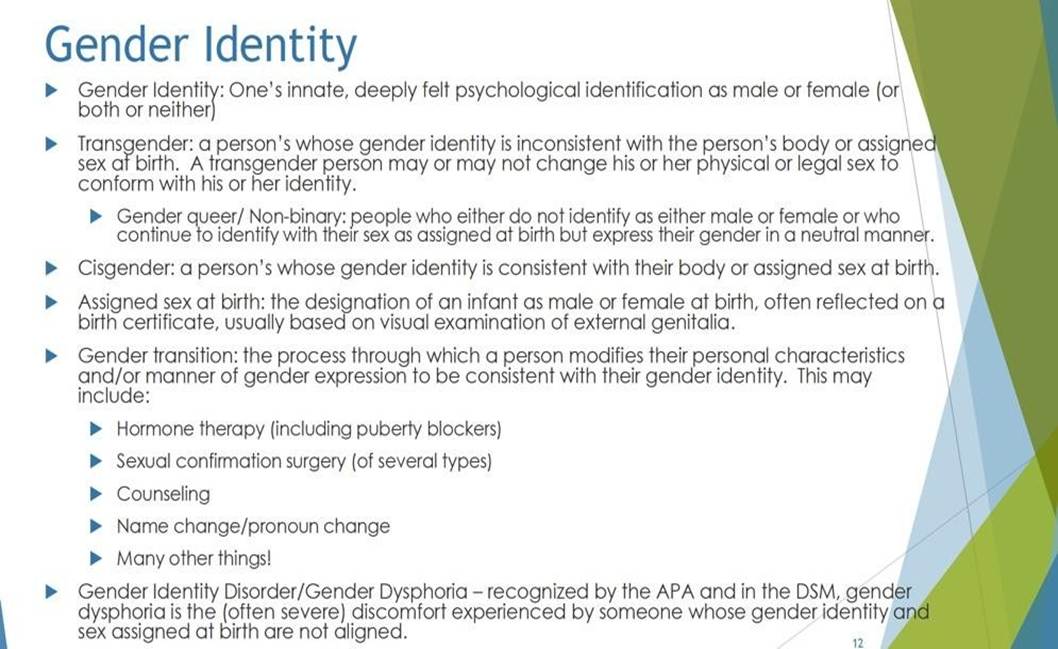
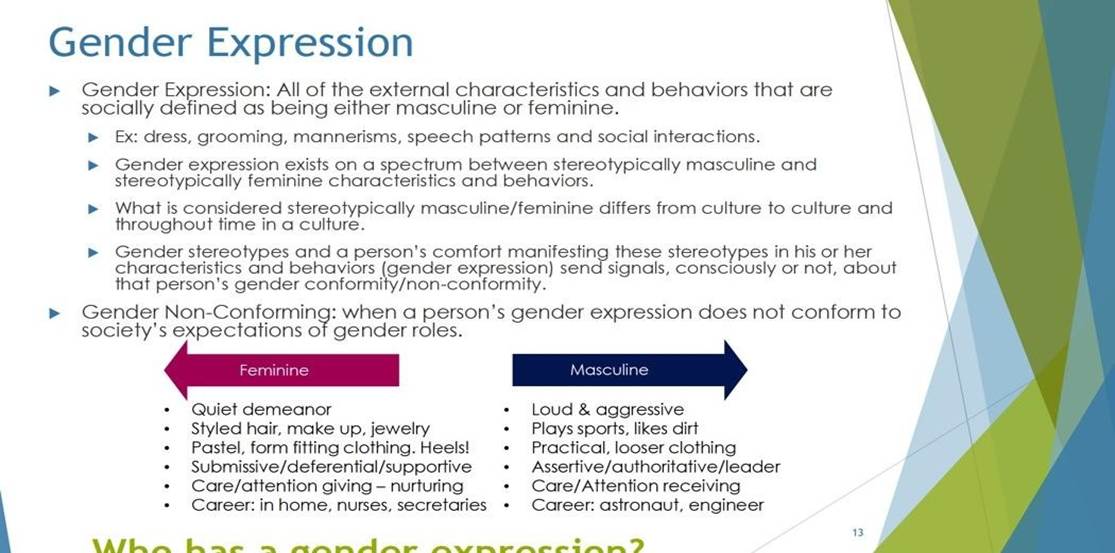
The presentation is a development and comprehensive examining the legal, social challenges that our LGPTQ community face every day. It will show the insights from the Virginia Continuing Legal Education through seminar that features Cathryn Oakley of Human Rights in Washington D.C. She will show the audience the foundational concepts and discrimination that go along with the civil rights problems. The outcome and core definitions regarding the difference in identity, gender and the transition to a nonconformity to establish a clearer legal literacy. Integrated data is visual and highlights the statistics on discrimination, prejudice and challenges that the LGPTQ faces as an individual. It applies to the professional insights that legal experts and organizations through the current policy when it comes to civil rights.
My skills will demonstrate: Legal Research & Synthesis. Data visional and design, Civil rights policy, and the Matter of Education from the advocacy Communication.
LGBTQ Legal Issues and Challenges
Much of the information gained that is presented in this powerpoint is credited to Cathryn Oakley, Human Rights Campaign (Washington DC) and the above
named VACLE seminar
DISCRIMINATION AND PREJUDICE FACED BY LGBTQI+
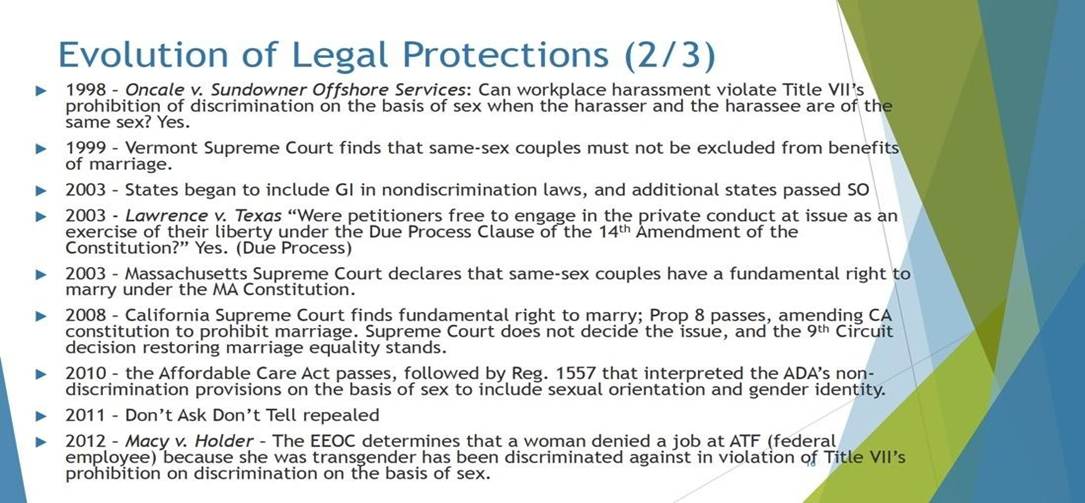
LGBTQI+ (Early Decisions)
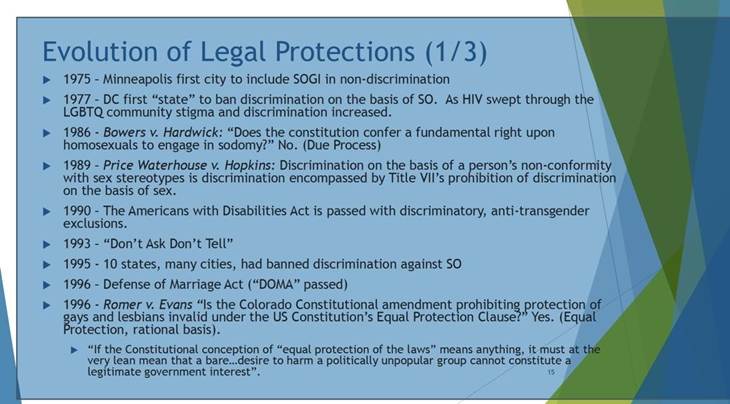
LGBTQI+ (Early 2000s)
LGBTQI+ (Most Recent)
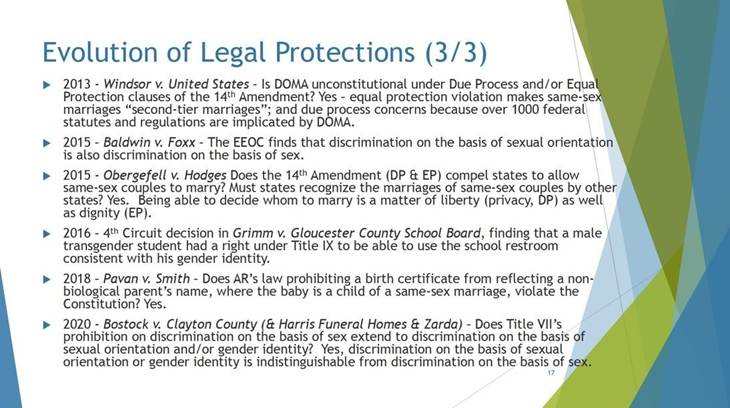
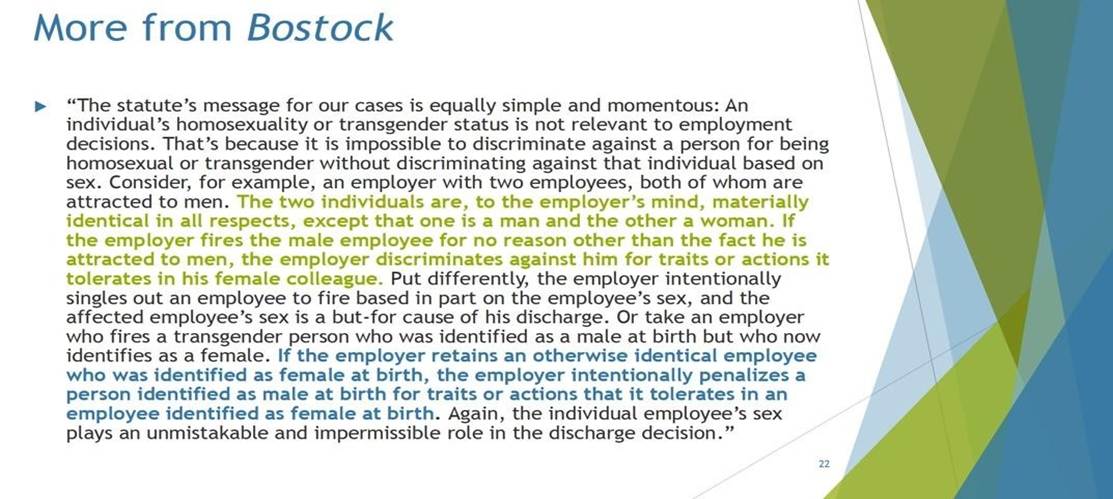
Major Supreme Court Decision 2020
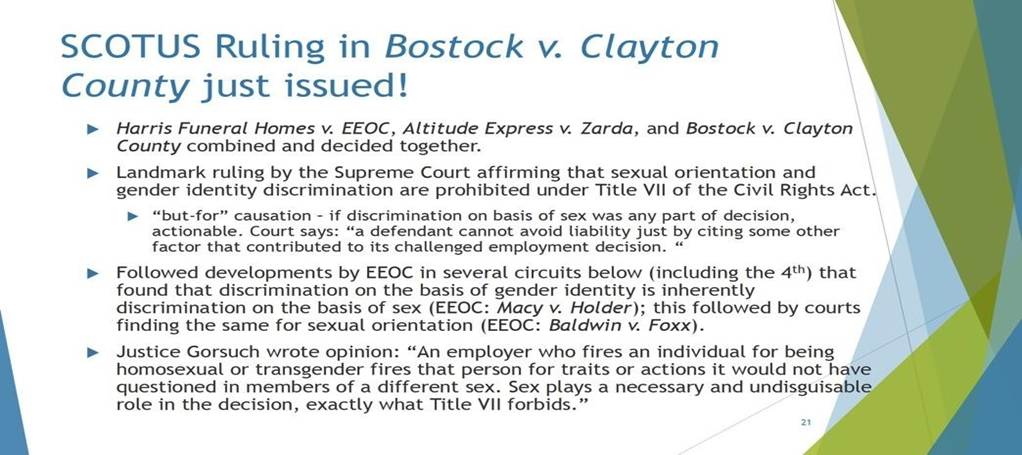
Bostock will have significant implications on future court decisions
Virginia Values Act
- VVA creates all-new protections for Virginians in private employment and places of public accommodation on the basis of race, color, religion, national origin, sex, sexual orientation, gender identity, pregnancy, childbirth or related medical conditions, age, marital status, disability, and status as a veteran.
- Prior to VVA Virginia did not have well documented non-discrimination laws for LGBTQ, this legislation package helped bring the state more in line with other states regarding employment, housing, and public accommodations.
- VA also did not have laws limiting discrimination in private employment despite most states having laws protecting in private environment.
Artifact 7 Fall 2026
Computer Skills I have learned throughout my college journey
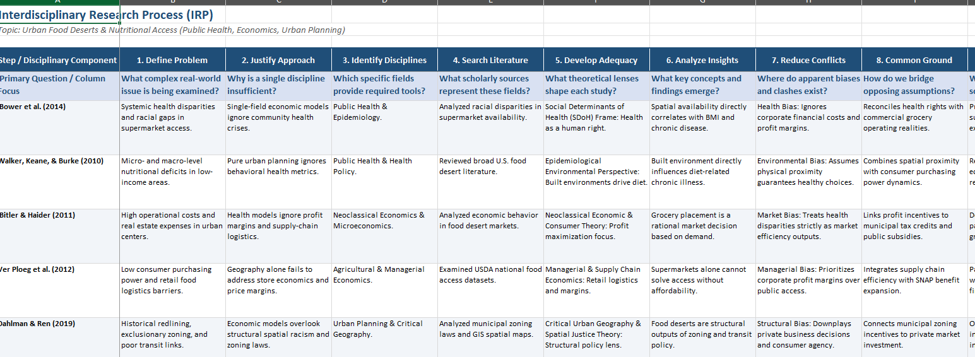
Interdisciplinary Research on the Urban Food Deserts & Nutritional
Artifact will show the advancement of interdisciplinary research by examining the health in the urban planning limited the economic from the surrounding food deserts in the United States.
Skills Highlight, the successfully integrated and framework in Public Health, and the Economic within the Urban Planning complex of societal issues that couldn’t be solved through one lens. It Mapps out the analysis of literature of Bower et al. and others across the methodological steps, that is define as a problem boundary of theoretical lenses and evaluating the main conflict that builds the common ground.
It shows the historical zone, logistics and microeconomic market that impact community health outcomes of nutritional access for the urban areas.
This project shows my ability that breaks down real-world challenges and diverse academic and professional data to balance comprehensive solutions. It also reflects my critical thinking skills throughout my Leadership coursework at Old Dominion University.