Fists in the Air, World Watching:
The 1968 Olympic Salute and the Media Machine
The act itself
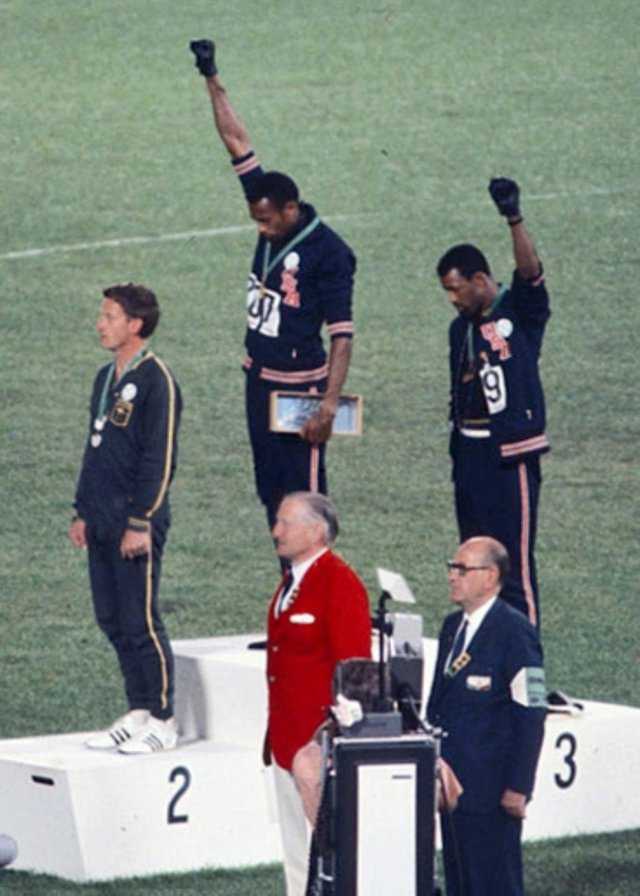
On October 16, 1968, American sprinters Tommie Smith and John Carlos stood on the medal podium at the Mexico City Olympic Games after finishing first and third in the 200-meter final. As the Star-Spangled Banner played, each man bowed his head and raised a black-gloved fist toward the sky. Smith wore a black scarf around his neck; Carlos wore beads. Both athletes removed their shoes, standing in black socks to represent Black poverty in America. Australian silver medalist Peter Norman wore an Olympic Project for Human Rights badge in solidarity.
The gesture lasted roughly 40 seconds. Its reverberations lasted decades. The International Olympic Committee expelled Smith and Carlos from the Games within 48 hours. They returned home to death threats and widespread public condemnation. Yet over time, the image — captured by photographer John Dominis — became one of the most recognized acts of sports activism in history, now taught in classrooms worldwide as a defining moment where sport and civil rights collided.
| DURATION OF GESTURE ~40 sec | DAYS BEFORE EXPULSION 2 days | YEARS TO REHABILITATION 30+ yrs |
How the outside media covered it
The immediate media response in the United States was overwhelmingly negative — not just critical of the message, but personally hostile toward Smith and Carlos as individuals. Major newspapers and sports outlets framed the act as an embarrassment to the nation rather than a legitimate political statement. Time magazine published the iconic Dominis photograph on its cover, but the editorial framing was disapproving. The dominant narrative in mainstream U.S. media positioned the salute as a violation of Olympic spirit — importing domestic politics into an international event meant to transcend them. Internationally, coverage was more mixed: some European outlets recognized the civil rights context more sympathetically, while the Soviet press used the images as Cold War propaganda about American racial inequality.
Social media: not yet, but not irrelevant
Social media did not exist in 1968, so Smith and Carlos had no direct channel to audiences. They could not post a statement, correct a mischaracterization in real time, or build a following that bypassed traditional gatekeepers. This absence is itself analytically significant: every word the public read about the salute was filtered through editors, producers, and institutions that were, by and large, hostile to the message.
What existed instead was community media — Black newspapers like the Chicago Defender and the Pittsburgh Courier, which framed the salute in a fundamentally different way, situating it within the long arc of civil rights struggle rather than treating it as an act of ingratitude or rule-breaking. These outlets reached a different, more sympathetic audience, creating what we might today call an “alternative media ecosystem.” The contrast between mainstream coverage and Black press coverage of the same event is a case study in how media framing shapes perceived meaning.
Did Smith and Carlos shape their own narrative?
To a meaningful but limited degree, yes. Smith in particular was deliberate and articulate in interviews immediately after the ceremony, explaining the symbolism of each element of the gesture: the black glove, the beads, the bare feet. He wanted the act to be legible, not ambiguous. In this sense, they attempted to pre-load the narrative with meaning — to give journalists a framework for accurate interpretation.
But they had little structural power over how that framework was received or used. Their words appeared in print alongside editorials condemning them. Without a direct-to-audience channel, their explanations were subordinate to whatever framing a publication chose to apply. The tools to assert narrative control simply did not exist yet.
Did the media narrative enhance or suppress the impact?
The answer is: both, in sequence. In the short term, the media narrative suppressed the impact. Hostile framing, institutional condemnation, and the absence of sympathetic platforms meant that Smith and Carlos were largely defined by their punishment rather than their message. Public opinion polls at the time showed most Americans disapproved of the gesture.
In the long term, the photograph did what words could not. Because it circulated without requiring mediation — because viewers could look at it and form their own interpretation — the image gradually decoupled from the hostile editorial context in which it first appeared. As civil rights history was re-examined, as Black athletes of subsequent generations cited Smith and Carlos as inspirations, as academic curricula incorporated the salute as a turning point, the media narrative slowly inverted. The gesture went from being framed as shameful to being framed as brave.
This long arc suggests something important: a sufficiently powerful visual act can eventually overpower the narrative built around it. The media’s initial suppression delayed the impact but could not prevent it. What Smith and Carlos did on that podium was legible enough, human enough, and visually striking enough that it kept generating new meaning long after the original context faded.