Exploring Culture
The TalkAbroad assignments gave a very good insight into what culture is like in other Spanish-speaking countries. While discussing topics such as what family structures are like and different food preferences are, I was able to make comparisons of what life is like in Spanish cultures and how they differ from my life in the States. Several of our textbook assignments also went over cultural concepts as well.
To reflect, the TalkAbroad assignments gave the most detailed description of what culture is like in other countries. I got to hear first-hand about what values my partner had and how a family unit typically operates in another country. She really valued spending any and all time that she could with her family, which differs a bit from family in the US where young adults will moved across the country to go to college or start their own lives. Another differenced was apparent in the La Comida chapter when my partner discussed the typical meal time differences; many Spanish-speaking countries eat a bigger lunch and smaller dinner which differs from American families who typically eat a larger dinner. The artifact is included below for my TalkAbroad recording.
Engaging in Communities
There is a significant importance in engaging in immediate community because people need to have a deep understanding of what goes on around them that is outside of their scope of knowledge. When people have a better understanding of how other countries live their lives, they are able to understand people on deeper, more meaningful level. There is value in engaging in your community because if you want to change some aspects of life, you have to first understand it well. The same goes for engaging in the global community. We can adopt ways of doing things that other countries do if they could benefit us, as well as share improvements with others.
Interpersonal Communication
https://drive.google.com/file/d/16Sl9bmCCZhcaP5pcvDmescoxTOiS_kvL/view?usp=sharing
During this semester, I had to participate in 2 TalkAbroad sessions with a Spanish-speaking individual from another country. In these sessions, I had a 2-way dialog about various topics, including Mi Familia and La Comida and utilized the relevant vocabulary from whatever chapter we were covering in class. Other assignments in our textbook required us to record answers to a staged dialog for our professor to evaluate and grade. Finally, in class, we participate in back and forth dialog with other classmates to practice speaking and pronunciation.
The TalkAbroad sessions helped me to practice what I learned from memory because I had no idea what my partner would be saying to me in response. This type of interpersonal communication was both spontaneous and planned because I was able to practice what I would say to an extent knowing the topic that would be discussed, however the responses were determined on the spot based on what my partner would say and ask me next. The assignments that were done in our textbook were more planned assignments and similar to conversations that we held as classmates. I struggled a little bit with speaking to classmates because sometimes their responses were not always correct and I worried that I would be practicing improper Spanish. I also had a little bit of a hard time with keeping the flow of talking going while trying to come up with what I was trying to say. Next time, I would spend more time on practicing conversational Spanish with people who are fluent in the language.
Presentational Speaking
For presentational speaking, we made a video on how to cook a dish and gave direction for the recipe in Spanish. In this project, I came up with a general script of instructions that I read to give simple instructions on how to cook Chorizo, a dish that I ate frequently in my Hispanic household when I was growing up.
I enjoyed this project the most because we had the most say in what we would talk about for it. I found it easier to discuss this topic as well because cooking and eating is something that I have already had experienced listening to and interpreting when I was growing up. I struggled al little bit with keeping a tone of voiced that sounded natural for this project. I am not a strong public speaker as is and was nervous to do this assignment in Spanish. Next time, I would practice a few times before a live audience to get more comfortable with my flow of speech and better my public speaking.
Presentational Writing
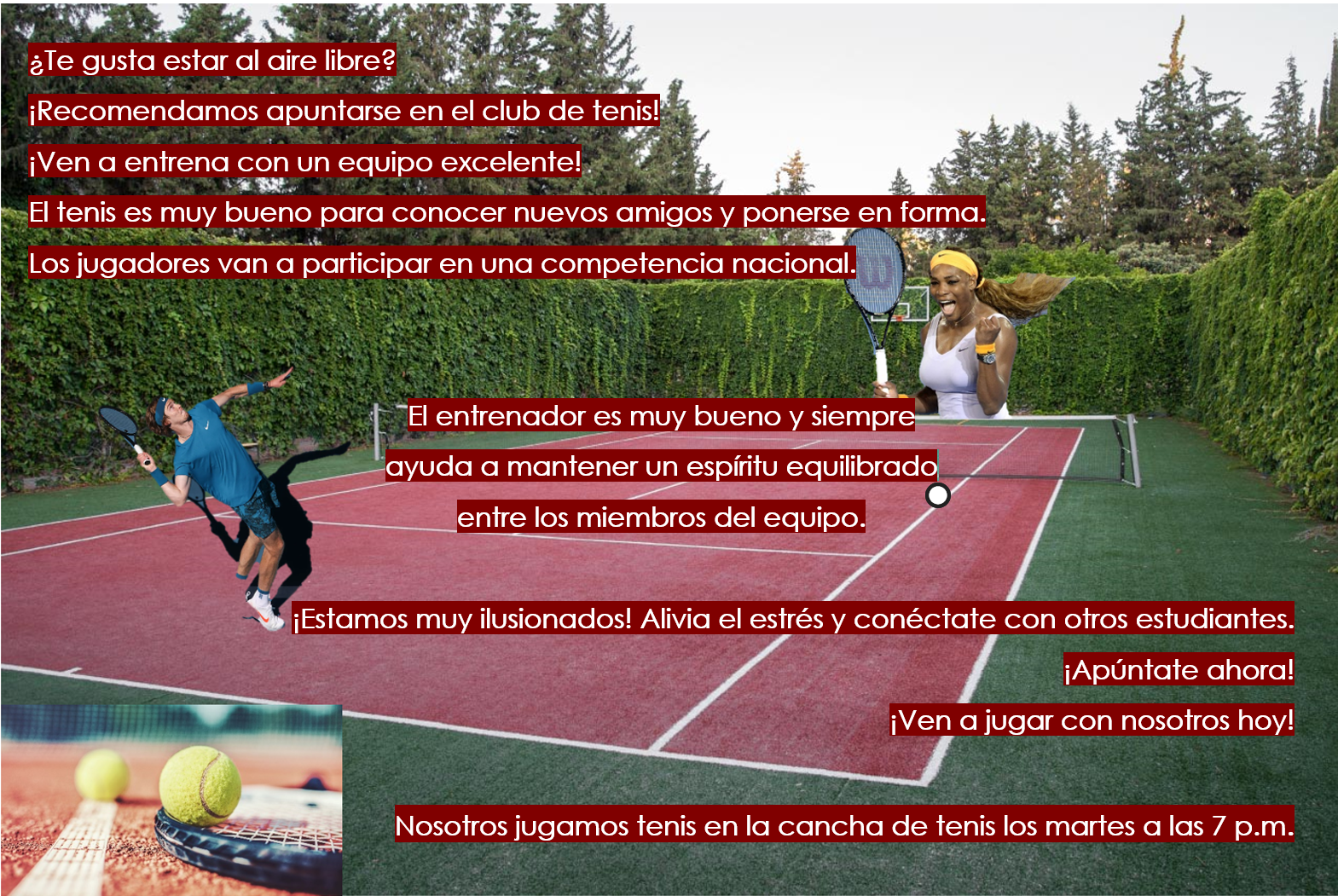
For Presentational writing, we participated in a project where we had to make a poster advocating for a sports club or team to join. This helped us to use vocabulary and incorporate visual aids to help reinforce concepts that we were learning at the time. Another poster that we made was to give information on a health issue or topic and I did mine on how to get a good night of sleep.
I definitely think that I had an easier time with our posters towards the end of the semester. The sports poster was interesting to do, but I did find it easier to do the health poser that required a little more research. I had a better understanding of the topic I was writing about towards the later assignments. I found it easier to write about a topic when I felt like I was better informed on it and for future assignments, I would better prepare for assignments by doing some research first.
Interpretive Listening

In our textbook, we would frequently be required to listen to short excerpts and then answer a series of questions about what information we gathered from them.
We have participate in several instances of interpretive listening this semester. From listening to our professor in class to listening to short clips in our homework, it is very beneficial to the learning of the language to use context clues to figure out what is being said. I was able to learn words that I wasn’t sure what they meant by the words that I was familiar with in the rest of the sentence.
Interpretive Reading
Some examples of interpretive reading that we did in class were during homework assignments when we would have to read excerpts about cultural experiences in different countries before having to answer questions. These were typically very short and we could read through once and then skim through again looking for key words or phrases if we forgot what we read.
Questions that we were asked were usually pairing answers to the correct person who said the answer. I had a bit of a hard time retaining the information and had to frequently go back and forth to get all the questions answered. I would like to get better at remembering what I have read once I am more fluent in Spanish. I tried to overcome the issue by reading the questions first, and this helped a bit but not that much. I have gotten better since the first assignment so there has been some growth. I think this is just something that will take time to improve at.