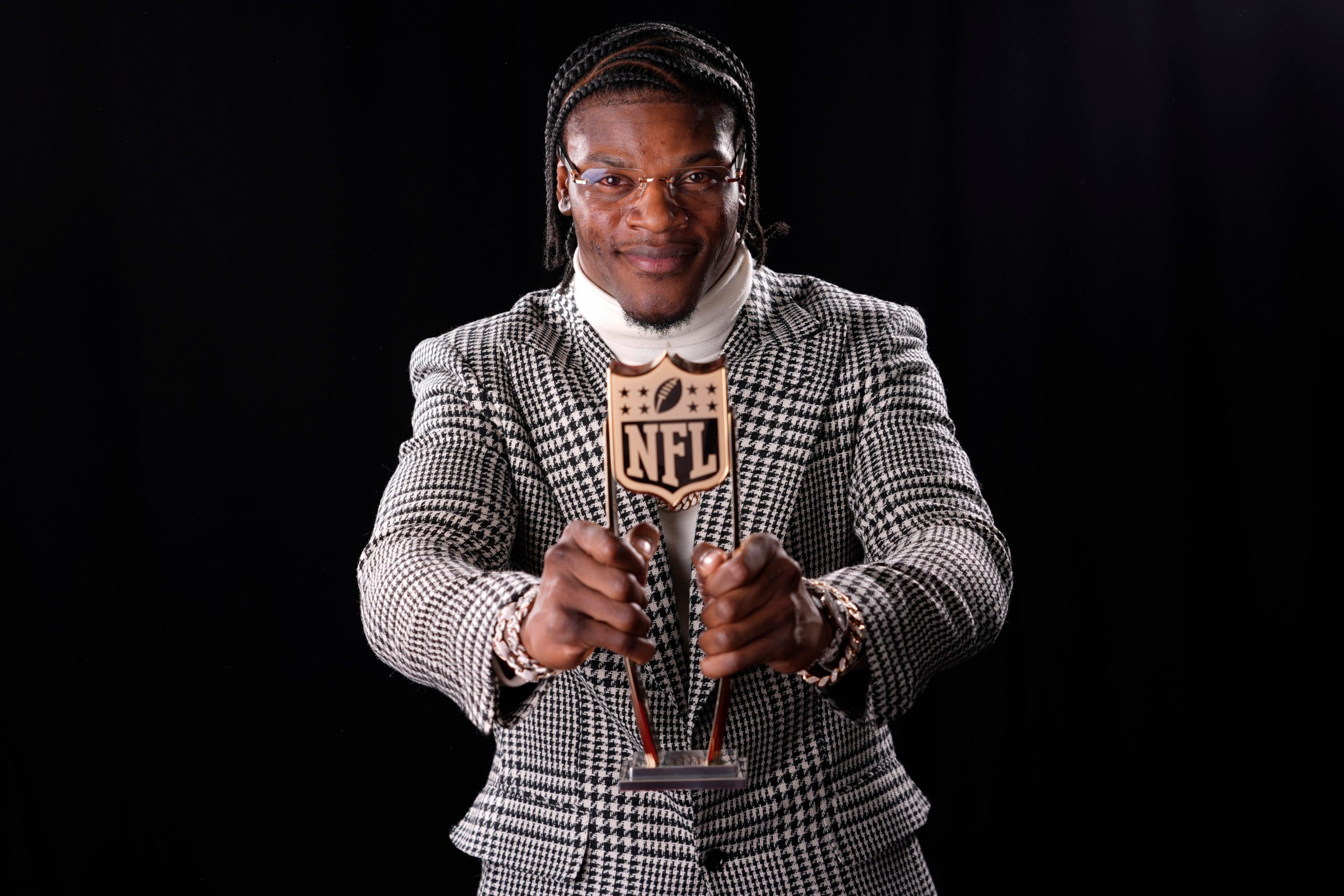
It started with a smirk.
Lamar Jackson sat quietly next to his mom on draft night, wearing a look that was somewhere between calm and slightly annoyed. Quarterback after quarterback got picked before him—even ones who hadn’t come close to matching his college numbers or impact. Despite winning the Heisman Trophy and lighting it up at Louisville, Jackson slipped to the final pick of the first round.
When the Ravens finally took him at 32nd overall, he didn’t lash out. He didn’t rant. He pulled the Baltimore cap down low and looked into the camera with a confident message:
“They gonna get a Super Bowl out of me. Believe that.”
But instead of celebrating that moment, a bunch of analysts and fans immediately questioned whether he should even be a quarterback. Some said he’d be better off switching to wide receiver. Others laughed him off as just a runner. That was the beginning of what would become a constant theme in Lamar’s career—being doubted and misunderstood no matter how much he accomplished.
From the second he got to the league, people have questioned Lamar Jackson. His passing was called inconsistent. His style was labeled as “unsustainable.” Even though he dominated college football and ran one of the most complicated offenses at Louisville, he wasn’t given the benefit of the doubt. If we’re being honest, that’s something a lot of Black quarterbacks have dealt with in the NFL—praised for their athleticism but rarely respected for their intelligence or leadership.
And then came 2019.
Lamar put the entire league on notice. He led the NFL in touchdown passes. He broke the single-season rushing record for a quarterback. The Ravens finished 14–2, and he won MVP unanimously—something only Tom Brady had done before him.
He didn’t stop there. In 2023, he claimed his second MVP award, becoming just the 11th player in NFL history to win multiple MVPs. That season, he led the Ravens to another AFC title run and proved, once again, that his impact goes beyond stats—he’s a winning quarterback who elevates everyone around him.
You’d think that would’ve shut people up. It didn’t.
Even with two MVPs under his belt, critics kept calling him “RB1” and saying defenses would figure him out. When Baltimore got knocked out of the playoffs in 2019, the noise got even louder. It didn’t matter that his playoff numbers weren’t terrible or that he was still learning as a young QB. The goalposts kept moving.
There’s something incredibly frustrating about being great and still having to prove yourself constantly. But Lamar’s story isn’t just about football—it’s about the way we view quarterbacks and the outdated expectations we place on them.
There’s this weird double standard. When white QBs run, it’s “smart mobility.” When Lamar runs, it’s seen as a flaw. Even now, in a league full of dual-threat quarterbacks, he’s still treated like an outlier instead of a trendsetter.
What people miss is how much Lamar has evolved.
Since Todd Monken took over as offensive coordinator in 2023, Lamar has looked more comfortable and balanced than ever. His accuracy has improved, he’s staying calm under pressure, and he’s making smart throws. He still uses his legs—because why wouldn’t he?—but he’s clearly shown he doesn’t rely on them to win games.
And in 2024, he delivered the best season of his career.
Lamar threw for a career-high 4,172 passing yards and 41 touchdowns with just 4 interceptions, finishing the year with a passer rating of 119.6. On the ground, he added 915 rushing yards and 4 rushing touchdowns. In the regular-season finale against Cleveland, he became the first player in NFL history to record over 4,000 passing yards and 800 rushing yards in a single season.
The Ravens ended the regular season with one of the best records in the league and made it to the AFC Divisional Round, where they lost a tight 27–25 game to the Bills. Despite the early exit, Jackson finished second in MVP voting, barely edged out by Josh Allen. But the performance spoke for itself—his dual-threat dominance hit historic levels, again.
And let’s not forget the contract situation.
Lamar represented himself. No agent. No media circus. He negotiated directly with the Ravens and stood his ground, even when people in the media called him unreasonable. In the end, he signed a five-year, $260 million deal—the highest-paying contract in the NFL at the time. That alone should’ve earned him more respect, but instead, it turned into another moment where people questioned his decisions.
Through it all, Lamar has stayed quiet and focused. He doesn’t need headlines or drama. He just wants to win. His teammates love him. He’s known for being humble and always putting the team first. You don’t see him in the news for the wrong reasons. He’s a leader in every sense of the word.
In a 2023 post-game interview, Jackson addressed the ongoing criticism:
“I play quarterback. At the end of the day, I’m trying to win games. However I need to do that, that’s what I’m going to do. I’m not worried about the labels.”
It’s honestly wild that some fans and commentators are still unsure about him. He’s won more games than most of the QBs from his draft class. He’s made the Ravens legit contenders. And when you actually watch the games—not just the clips on Twitter—you see how much control he has over the offense. He’s making reads, shifting protections, and doing everything a quarterback is supposed to do.
The whole “running back” joke? It was never funny, and it’s never been accurate. It’s lazy, and at this point, it’s just flat-out disrespectful.
And the impact of this narrative isn’t just media noise—it’s rooted in long-standing racial dynamics in the NFL. A 2022 study by The Undefeated (now Andscape) reported that Black quarterbacks are still less likely to be described using terms like “smart” or “leader” in scouting reports, while white quarterbacks are more often praised for mental traits. Lamar’s experience fits right into that trend.
What Lamar Jackson is doing matters. He’s changing the way people think about the position, whether they like it or not. And even if some folks are slow to admit it, kids watching him play know exactly who and what he is. They see a quarterback who looks like them, plays his own way, and leads with confidence.
Lamar doesn’t fit the old mold—and that’s a good thing. He’s breaking it. He’s rewriting it. And in doing so, he’s opening the door for a whole new generation of quarterbacks who don’t have to check every outdated box to be considered elite.
He was never just a running back.
He’s always been a quarterback—some people are just finally catching up.