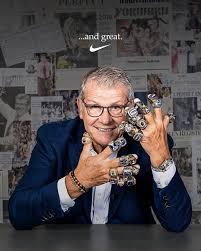
When Geno Auriemma walks into the gym, he doesn’t see banners. He doesn’t see trophies. He doesn’t even see the dozen or so national championships hanging like monuments to dominance in Storrs, Connecticut. What he sees, what he’s always seen are young women who don’t yet know how great they can be and maybe that’s his real genius. To the casual sports fan, Geno Auriemma is the architect of the University of Connecticut women’s basketball dynasty, with eleven NCAA titles, a perfect season here, a record-shattering win streak there. However, to his players he’s something different, something deeper. Geno Auriemma is a craftsman of confidence, a provocateur of potential, and sometimes, a pain in the ass. “Coach will tell you the truth when no one else will,” former UConn star Sue Bird once said. “Even when it stings. Especially when it stings.”
Born in Italy and raised in Pennsylvania, Auriemma didn’t come to basketball with a golden ticket. He came with grit, a kid who learned English secondhand and hustled his way into coaching. When he took over UConn’s women’s team in 1985, the program had exactly one winning season in its history and the locker room barely had hot water. No one was watching. “I remember the first time I walked into Gampel Pavilion,” Auriemma said years later. “We had ten fans. And I think three of them were lost.” Fast forward three decades, and UConn isn’t just a powerhouse, it’s a beacon. Auriemma didn’t just build a program; he reshaped the landscape of women’s sports, and he didn’t wait for the spotlight, he dragged it into the gym.

Coaching the Person, Not Just the Player
For all the accolades, Olympic gold medals, Coach of the Year awards, a Hall of Fame induction, Auriemma’s greatest work might not be measurable by wins but it’s visible in the eyes of the women he coached, many of whom went on to transform the WNBA, serve as coaches, analysts, and leaders in their own right. Take Maya Moore, Diana Taurasi, or Breanna Stewart. The names are iconic now, but before they were legends, they were kids. Kids with talent, sure but also with doubts. “Geno didn’t just teach me how to play,” said Taurasi, one of UConn’s fiercest competitors. “He taught me how to fight for something bigger than myself. He taught me how to lead.” His coaching style isn’t soft. It isn’t always gentle. He’s known for calling players out, for making them uncomfortable, for challenging their sense of self, but here’s the thing, it works. “He saw something in me I didn’t even see in myself,” said Stewart. “And then he made me believe it.”
Geno Auriemma’s legacy isn’t just about basketball. It’s about equity, visibility, respect. For decades, women’s sports have battled for airtime, for resources, for the simple right to be taken seriously. Auriemma didn’t ask for that respect, he demanded it. Through excellence, through consistency, and through refusing to treat women’s basketball as a “lesser” version of the men’s game. He coached with the same fire, the same expectations. And in doing so, he rewrote the narrative. “When you watch UConn play, you don’t think, ‘Oh, this is good for women’s basketball,’” said one ESPN analyst. “You just think, ‘This is good basketball.’ Period.”
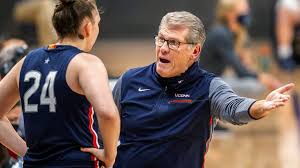
The Cost of Greatness
Of course, not everyone loves Geno. He’s sharp-tongued, brutally honest, and doesn’t sugarcoat failure. His critics say he’s too harsh, too arrogant, too relentless, and maybe that’s the tax you pay for greatness, for demanding more and not just from others, but from yourself. In recent years, with the game evolving and new challengers emerging South Carolina, LSU, Iowa, UConn has found itself human again; Vulnerable, beatable, yet, there’s something poetic about it because for Geno Auriemma, the legacy isn’t just about staying on top. It’s about lifting others up. In postgame interviews, you’ll still catch glimpses of the fire, the frustration, but you’ll also hear something else, a softness earned by decades of watching young women become something more. “We don’t just win games here,” he said once. “We grow people.”
At 70, Geno Auriemma is still coaching. Still teaching. Still believing. And when he eventually steps away, he’ll leave more than a full trophy case. He’ll leave a standard. A blueprint. A reminder that women’s sports aren’t waiting for a moment—they’re building a movement and somewhere in a quiet gym in Connecticut, a whistle will blow. The game will begin. And Geno, as always, will be watching—not for the perfect play, but for the spark. The spark that says, “I didn’t know I could do that.”
But he did.