Original Activity Using Authentic Materials
Activity Name: Calvin Found Something to Do!
Class Description: This activity is designed for a B1 intermediate level class.
Objectives: By the end of the activity, students will be able to:
- Describe a series of events using simple past and past progressive tense
- Use the chronological markers while and when
- Be able to distinguish when to use either when or while
- Narrate a story in chronological order using simple past and past progressive tense
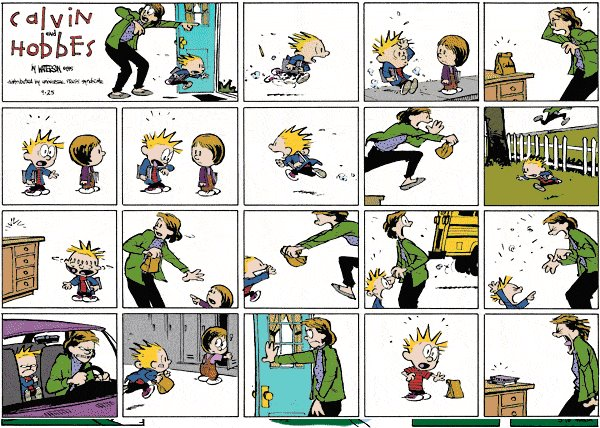
Authentic Materials Used: Students will verbally narrate from start to finish the plot events of a wordless Calvin and Hobbes comic strip.
How does this activity replicate language students will use outside the ESL classroom?
Narrating past events in chronological order, in the simple or progressive tense, and with chronological words is an important life skill because students may have to recount chronological events in their school, work, or personal lives. Effective storytelling and narration require the use of transitions and chronological terms, as well as the simple and progressive past forms. This activity will also facilitate students’ ability to connect language to visuals, and this facilitates language acquisition.
Steps for the students and teacher:
- The teacher reviews chronological words and both simple and progressive past prior to the start of the lesson.
- Students learn the difference between the words when and while with examples.
- Teachers puts comic on board for students to read and also prints the comic on papers for each student.
- Students read the comic and complete both activities.
Appendix A:
Appendix B:
Student Activity #1: Past Simple versus Past Progressive
Read each sentence and determine whether simple past or past progressive is more appropriate.
- Calvin (ran/was running) outside to the bus stop; Susie (waited/was waiting) there.
- Calvin’s mom (saw/was seeing) Calvin’s lunch bag.
- Calvin (remembered/was remembering) his forgotten lunch.
- Calvin (ran/was running) back to the house.
- Calvin’s mom (ran/was running) to Calvin.
- Calvin (ran/was running) to the house; Calvin’s mom (ran/was running) to the bus stop.
- Calvin (looked/was looking) for his lunch.
- Susie (pointed/was pointing) to where Calvin was.
- Calvin’s mom (gave/was giving) Calvin his lunch.
- The school bus (drove/was driving) away; Calvin and his mom (panicked/were panicking).
- Calvin and his mom (yelled/were yelling) at each other.
- Calvin’s mom (drove/was driving) Calvin to school.
- Calvin (ran/was running) to his locker; Susie (opened/was opening) her locker.
- Calvin’s mom (went/was going) back in the house.
- Calvin (remembered/was remembering) another forgotten thing.
- Calvin’s mom (saw/was seeing) Calvin’s forgotten schoolbooks; She (screamed/was screaming).
Student Activity #2: When vs. While
In sentences #1, #6, #10, #13, and #16, two different events are happening at the same time. Using the format below, determine whether when or while should be used to describe the two different events in each sentence.
(By this time, correct answers have been given for how to write Sentences #1 – #16 in Activity #1, so they are shown below.)
#1: Calvin ran outside to the bus stop (when/while) Susie was waiting there.
#6: Calvin was running to the house (when/while) Calvin’s mom was running to the bus stop.
#10: Calvin and his mom panicked (when/while) the school bus drove away.
#13: Calvin was running to his locker (when/while) Susie was opening hers.
#16: Calvin’s mom screamed (when/while) she saw Calvin’s forgotten schoolbooks.
Student Activity #3: Tell the story!
In pairs, students will verbally narrate the events illustrated in the comic strip using the simple past and past progressive. For the events in Activity #2 that happen at the same time, students should use either when or while as appropriate. Students should use terms from the “chronological word bank” below to connect together the different events in the story.
Chronological word bank:
First Then/And then After that Meanwhile Finally/Lastly