Cybersecurity problems rarely exist within a single technical discipline. They are also shaped by human behavior, communication, public policy, organizational structures, culture, and the way people interpret information. My interdisciplinary coursework taught me to examine those relationships more deliberately and to communicate cybersecurity issues without reducing complex problems to purely technical explanations. The artifacts below show that development from an early exploration of cybersecurity awareness and digital literacy, through formal interdisciplinary research, to an advanced analysis of cyber operations, information warfare, and resilience during armed conflict.
Cybersecurity Awareness and Digital Literacy
Course: CYSE 201S – Cybersecurity & Social Science
Artifact Type: Research Presentation
Artifact Description:
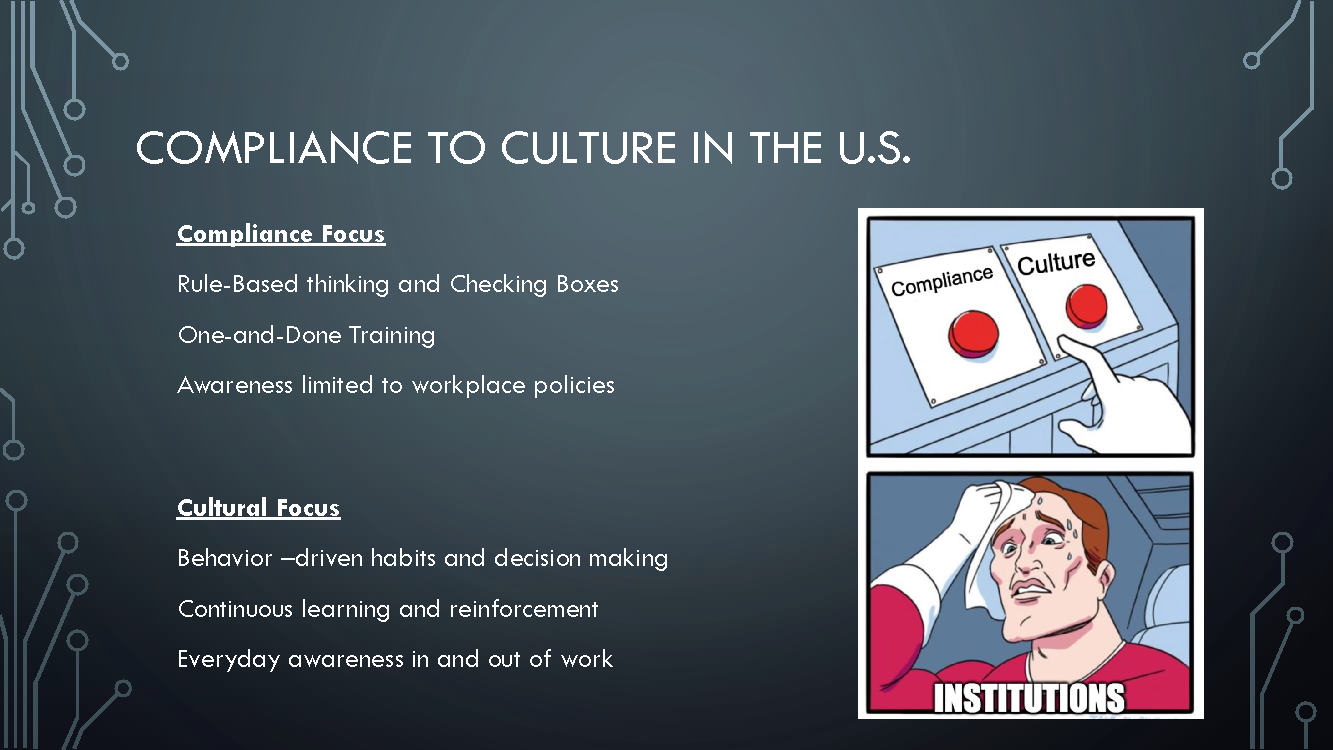
This presentation examined cybersecurity awareness through behavioral and social-science perspectives rather than treating awareness as a list of technical rules. I compared surface-level security guidance with deeper approaches that teach users to recognize social engineering, evaluate trust, understand digital privacy, and question online information. The presentation also examined human behaviors such as password reuse, phishing susceptibility, cognitive bias, misinformation, and breach apathy and compared awareness approaches in Finland, Estonia, and corporate training programs. The central argument was that effective cybersecurity awareness requires moving from compliance-based training toward a culture in which secure digital behavior becomes a continuing habit.
Skills Demonstrated
- Human-centered cybersecurity analysis
- Cybersecurity awareness and training concepts
- Social-science application to cybersecurity
- Digital and media literacy
- Social engineering awareness
- Comparative program analysis
- Presentation and audience communication
Interdisciplinary Analysis of Public Trust and Institutional Resilience
Course: IDS 300W – Interdisciplinary Theory and Concepts
Artifact Type: Interdisciplinary Research Paper
Artifact Description:
This research project examined why public trust in local institutions has remained more resilient than trust in national institutions. I approached the problem through political science, media studies, and sociology, comparing how each discipline explains institutional trust through performance, media framing, and social proximity. The project required identifying conflicts among those disciplinary perspectives and developing common ground rather than selecting one explanation as correct. I ultimately used the concept of “closeness” to integrate geographic proximity, cultural familiarity, media exposure, institutional performance, and direct community experience into a broader explanation of how trust is created or lost.
Skills Demonstrated
- Interdisciplinary research
- Integration of multiple disciplinary perspectives
- Political and institutional analysis
- Media and information analysis
- Sociological analysis
- Identification of disciplinary conflict and common ground
- Research synthesis and analytical writing
Militarized Cyberspace in the Russia-Ukraine War
Course: CYSE 426 – Cyber War
Artifact Type: Advanced Cybersecurity Research Paper
Artifact Description:
This research project examined the extent to which cyberspace has become militarized during the Russia–Ukraine War while distinguishing technical cyber operations from information warfare and strategic communication. I analyzed Russian operations including WhisperGate and the KA-SAT/Viasat attack, Ukraine’s defense against Industroyer2, broader Ukrainian digital resilience, and the use of compromised media platforms and social media in wartime information campaigns. The project required comparing competing academic interpretations of cyberwar, evaluating tactical, operational, and strategic effects, and revising my initial assumption that destructive cyberattacks, propaganda, and other digital operations could be treated as a single category.
Skills Demonstrated
- Cyber conflict and national-security analysis
- Critical evaluation of competing academic arguments
- Cyber operations and information-warfare distinction
- Strategic and operational effects analysis
- Digital resilience analysis
- Source evaluation and research synthesis
- Evidence-based revision of assumptions
- Advanced analytical writing