Communicative Competence: Speaking and Listening
Interpretive, Interpersonal, and Presentational Modes of Communication
Exploring Culture
At the start of the course, I had superficial knowledge of different hispanic cultures, but I found that the discussions and conversations via Boomalang were the most helpful at expanding my knowledge. Also, we often watched short clips that allowed me to gain a deeper understanding of the small differences in culture.
The conversations allowed me to better understand the values and attitudes in Hispanic cultures because they came from people who are active in those communities. I was able to speak with people from Spain, Argentina and Venezuela, which gave me more specific cultural information and in a personal manner. They also challenged my worldview by opening up differences that I likely would not have thought of on my own. By participating in the various activities, I was able to overcome my limited knowledge and find an interest in the various cultural diversity. The course revealed how unique each culture is; for the most part, the basics of the traditions are very similar, but the details are unique to each culture. One good example of small cultural differences, came from our discussion of Christmas in the US versus the celebration of the three kings in Spain (Los Reyes Magos pictured below).
Engaging in Communities
The importance of engaging in our immediate and global community is that there is so much we can learn from them. We can grow our world views and be more openminded about the differences in ideas and cultures.
The class allowed us to engage in both our immediate and global community by using video chats. For our immediate community, we had daily Zoom meetings where we would have class and small group discussions (pictured below). We were able to exchange different ideas or work though activities together. For our global community, we were given two fifteen minute calls with native speakers through Boomalang. These chats were beneficial because gave us the opportunity to exchange ideas with someone who has had experiences we may not have in our immediate community. Both experiences allowed us to expand our Spanish skills, specifically our speaking ability.

Interpersonal Communication
In this course we completed several different activities for interpersonal communication. It was a large part of the class as we were constantly having discussions and other interactions with other students. We completed oral compositions, various interviews and discussion boards.
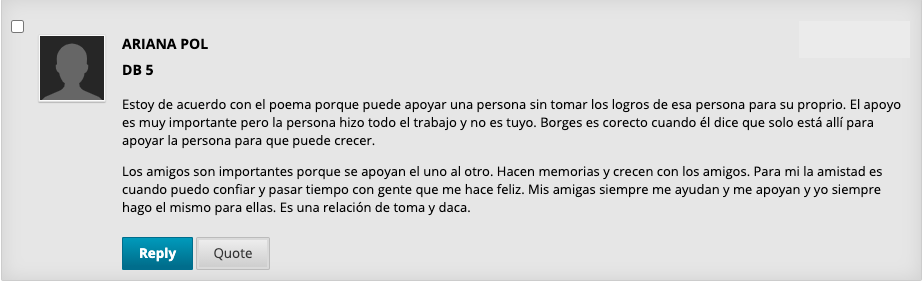
Our daily class always consisted of unplanned interpersonal communication, as we would analyze and discuss without knowing the topics beforehand. For our other exchanges, we had at least a little bit of time to prepare general ideas for responses. Examples of this kind of communication include all three types of interviews (one on one, partner, and group), Boomalang chats, and discussion board posts. The discussion board posts like the one pictured below always brought a new perspective when reading and replying to other classmates’ posts. Each activity was important in challenging us to new topics and making us practice further. Some activities were difficult because it involved unfamiliar vocabulary, but after lots of repetition and practice they became more natural.
Presentational Speaking
For this course, our presentational speaking was in the form of recorded videos. We had to prepare PowerPoints and pictures along with our speeches on specified topics.
The first presentation we gave was regarding happiness and its definition. I did well at having clear ideas and organization. However, I think I struggled with getting tongue tied and with my pronunciation. In class, we worked on pronunciation, which helped me understand how to form certain sounds. We also practiced speaking more often, which made me more comfortable with talking in Spanish. For the second presentation, we discussed a couple of phrases regarding love. I was more confident in my speaking abilities. In presentation two, I could have better practiced my presentation to make it more fluid and natural. Below there is a link to my second presentation, which shows my improvement during the course.
Interpretive Listening
We frequently watched interviews or speeches by the directors of the short films we watched in class. From these interviews and speeches, we were able to analyze their motives and what they wanted the viewer to get from their work.
These interviews allowed us to test our ability to interpret the author’s intentions in Spanish. The video below is an interview with comic artist, Alberto Montt, who’s work we discussed in class. By watching the interview, I was able to get a better understanding of the comic we read in class. I found this activity slightly challenging because comics can be ambiguous. I was able to overcome this challenge by gaining a better understanding of Montt and by exchanging ideas with other classmates. I found the interviews and speeches helpful because they added an important perspective to the work we were examining. These activities also helped me learn new phrases and improve my listening skills through hearing people from various Spanish speaking countries.
Interpretive Reading
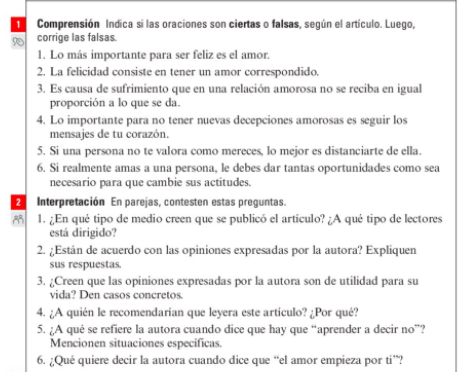
For each lesson, there was a short story or article that we analyzed and discussed. With each reading there were always sets of question like the ones pictured below. These activities allowed us to understand the main idea of texts and interpret or relate them to our own lives.
These activities were interesting because they either tested our understanding and knowledge of the text or brought up new discussion points. For the most part, the comprehension questions were very answerable because the answers could be found be simply rereading the text. The questions that invited you to interpret them were more challenging because some questions do not have a right answer. I liked the challenge of these questions because they allowed us to think more and be more creative with our answers. These activities were interesting due to them connecting us to other students in the class. I have grown with each assignment because I was able to use new skills and practice my analysis skills. The ability to analyze texts is crucial even outside of the Spanish classroom.