Category Archives: Hampton Roads History

Hampton Roads LGBTQ+ Community Snapshot 1977

By Mel Frizzell, Special Collections Assistant

In December 1977, the Norfolk Unitarian-Universalist Gay Caucus (UUGC) undertook what may have been the first survey of the LGBT community in Hampton Roads.  The survey was not intended to be a complete profile of the local gay community as those surveyed tended to be either bar goers or those active in the local Gay and Lesbian community.  Questions pertaining to the local Trans community were virtually non-existent.  Surveys were distributed in local gay bars including the Cue, the Nickelodeon, the Late Show, the Ritz, and at UUGC meetings.  The results of the survey were released in the January, February, March, and April 1978 issues of Our Own Community Press.  The January issue gave an overview of results.  The February issue featured the results as they pertained to women / Lesbians who took the survey.  The March issue shared results pertaining to gay and bisexual men.  The April issue highlighted comments made by survey respondents.

ourown_246

According to the February 1978 issue of Our Own, “The typical woman who filled out one of the UUGC questionnaires… is between 18 and 24 years old, lives in Norfolk, is registered to vote, Protestant, makes between $5-10,000, rents, has some college education, considers herself exclusively gay, attends a gay bar once a week, and always feels good about her sexuality.”  A total of 86 women responded to the survey.  

Older women were not well represented in the survey.  69% of the women surveyed were under the age of 24, and an additional 29% were between the ages of 25 and 34.  Only 2% of the women were over the age of 34.  Half of these respondents were from Norfolk, and the rest were from other cities in Hampton Roads with ten respondents from outside the area.  Two thirds of these women were registered to vote.  Political affiliation was not reported, but religious affiliation was.  Nearly half of the respondents identified as Protestant.  Nearly a third were Catholic.  A smaller number identified as Jewish, not religious, or other (including two who identified as witches).  48% of respondents had an annual income between $5,000-10,000, 29% had an income less than $5,000 a year.  Very few respondents made over $15,000 a year.  Only 14% of these women owned their own home; 68% rented, and 18% lived with parents, with a lover, or had other living arrangements.  Only 14% of these women had college degrees, 43% had completed some college, 35% had only graduated high school.  A very few women had advanced degrees or had not completed high school at all.  The highest number of these women (20%) worked in service and blue-collar industries.  17.5% of respondents were students and another 17.5% worked in government jobs.  Other jobs included healthcare, education, management, clerical jobs, merchandising, and artists.  Very few women surveyed were lawyers, journalists, engineers, or housewives.  8% of those women surveyed were unemployed.

Of the women surveyed, 8% claimed to be exclusively heterosexual, 44% considered themselves exclusively homosexual, and others claimed varying degrees of bisexuality.  Most of these women (84%) always or usually felt good about their sexuality.  14% had mixed feelings about their sexuality, and only one woman usually felt bad about her sexuality.   No one claimed to always feel bad about their sexuality.  36% of the women surveyed went to gay bars once a week, 28% went to bars only once a month, and 25% went to gay bars more than once week.  Only 22% of these women belonged to gay organizations, while 28% belonged to social groups; 20% to professional groups; 15% to political groups; 38% to special interest groups; and 13% to religious groups.  26% of the women surveyed did not belong to any organization at all. 

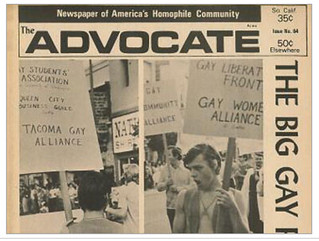
Popular LGBT publications among women were Our Own Community Press, The Advocate, Gay Blade, and Gay Community News.  Only a small number read Lesbian publications such as Lesbian Connection or Lesbian Tide.

LGBT-mens-survey-results1977

A total of 440 men answered the survey.  This was over five times the response rate for women.  The typical profile for men answering the survey was very similar to that of the women.  The typical man answering the survey lived in Norfolk, was between the ages of 18 and 24, was registered to vote, rented their housing, had some college education, was Protestant, had an annual income of $5,000-10,000, considered themselves exclusively gay, and always felt good about their sexuality. 

While the “typical” snapshot of respondents was similar, actual percentages varied and there were some differences between the men and women surveyed.  The typical male (49.2%) went to gay bars more than once a week whereas the largest number of women (36%) only went to bars once a week.  There was a larger number of men than women over the age of 24 who responded to the survey.  There were more men over the age of 35 and even some over the age of 50.  Men were less likely to have a religious affiliation at all, or if they did – to have a non-Christian affiliation (Jewish, Humanist, Buddhist, Moslem, B’ai H’ai, etc.).  Twice as many men than women had completed college, and men generally had higher incomes.  Women were slightly more likely be registered voters.  Men were more likely to consider themselves “exclusively” homosexual than women, but women tended to overall to feel better about their sexuality.  Men were more likely to belong to a gay organization or conversely to no organization at all than were women.

As for men’s statistics, 51.5% of men lived in Norfolk.  34.5% lived in other Hampton Roads cities.  The remainder came from other places in Virginia, Washington DC, or from out of state.  54% of men were aged 18-24; 34% were 25-34; 9% were 35-49; and 1.5% were over age 50.  45% of male respondents identified as Protestant; 25.5% as Catholic; 15.0% as none; 7.0% as other; and 4.5% as Jewish.  The highest percentages of men worked in either government or service jobs (16.2% and 16.4% respectively).  Other higher percentage occupations included students (9.7%); management (7.7%); healthcare (7.4%); merchandising (7.4%); and other professionals (7.0%).  Only 4.9% of men surveyed were unemployed.  65% of male respondents were registered to vote.   37% of those men surveyed had annual incomes between $5,000-10,000; 23.3% had annual incomes of $10,000-15,000; 17% had incomes over $15,000; and 20% had incomes under $5,000.  29.8 percent of the men surveyed had college degrees; 35.6% had some college; 27.8% had only graduated high school; and 5.9% did not have a high school diploma.  52.5% of men rented their housing; 21.0% owned their own home; and 23.5% had other living arrangements.

Of the men surveyed, 43.6% identified exclusively homosexual; 1.6% claimed to be exclusively heterosexual; and the rest claimed varying degrees of bisexuality.  79.6% of the men always or usually felt good about their sexuality; 18.7% felt both good and bad about their sexuality; and only 1.1% usually or always felt bad about their sexuality.  Nearly half the men surveyed (49.2%) visited gay bars more than once a week; 25.5% visited gay bars weekly; 18.2% visited gay bars once a month or less; and of these only .7% never visited gay bars.  26% of the men surveyed belonged to gay organizations; 37.3% belonged to no organizations at all.  Men also took part in professional organizations (27.3%), social organizations (26.2%), political organizations (14.1%), religious organizations (18.0%), and special interest groups (24.4%).

Popular publications among men included Our Own Community Press, The Advocate, In Touch, Gay Blade, Blueboy, Cruise, Gay Community News, Christopher Street, Gay Times, Eagle, GPU News, Drummer, Mandate, Playgirl, and After Dark.
AdvocateCoverPride
Stot, 2013: https://www.advocate.com/arts-entertainment/pride/2013/06/12/photos-remembering-birth-pride

While the demographics created a snapshot of LGBT bar goers and those active in the local LGBT community in 1977, the most revealing and sometimes entertaining portion of the survey were open-ended responses to the questions “What do you see as the greatest need of the lesbian/gay community of Tidewater?”  Overall themes to these questions included the need for unity and a sense of gay community; gay and straight education on gay issues; politics and legislation for gay rights; acceptance and understanding; more and better bars; and social outlets other than the bars.  

Comments included practical suggestions for the community – a Lesbian bar, live gay/lesbian music events, a gay military organization, a gay bookstore, a gay business association, an organization for aging gay men, a gay community center, and a gay church.  All of these things have come to pass in Hampton Roads (at least at some point) since the 1977 survey.  Some comments were idealistic like this one.  “For them to learn to live together.  To be friends no matter what color the person’s skin might be or what sex the person might be.  To be openminded with everything, because being gay is hard enough without fighting each other.”  Other idealistic responses included developing a unified gay/lesbian political philosophy, or ending division and labels within the community.  Some comments focused on educating the public on gay/lesbian issues, helping gay and lesbian folks to feel better about themselves, and helping folks come out of the closet.  There were also a few colorful comments by folks who obviously weren’t comfortable with segments of the gay/lesbian community at the time.  “The flaunting of homosexuality is the major problem.  The super “fags’ and ‘butch’ are what gives the rest of us bad names.”  Another respondent suggested, “More Gay Bars!… Make anyone over 40 stay out!  And have a special bar just for trolls.”  

Since 1977, hopefully at least some things have changed for the better in the Hampton Roads LGBT community.  Gay bookstores have come and gone, as have Lesbian bars.  LGBT military organizations have formed, especially at the height of the gay military ban and “Don’t Ask, Don’t Tell.”  We have an organization for aging Gay men, an LGBT business organization, and an LGBT community center.  There’s an LGBT church, and even room at the annual Pride month Interfaith event for non-Christians and LGBT folks involved in non-traditional religions such as Wicca and Paganism.  We have an LGBT Pride organization, an annual Pridefest, a Pride Boat Parade, and even a whole month of local Pride events.  While not well represented in the 1977 survey, we now have organizations and events for Trans folks in our community too. 

While we may have lost some things this past year or more due to Covid, this Pride month consider all that we have gained and learned since the early days of the Hampton Roads LGBT community.  What will the Hampton Roads LGBT community be like 44 years from now?

You can browse the issues of Our Own Community Press mentioned in this blog post, as well as all other issues of Our Own, in our digital collections: https://dc.lib.odu.edu/digital/collection/ourown

Virginia Symphony Celebrates 100th Anniversary

by Mel Frizzell, Special Collections Assistant

symphony-program1921

The Records of the Virginia Symphony Orchestra in the Old Dominion University Library’s Special Collections and University Archives document the history of the Virginia Symphony from its first concert in 1921 up to the present day.  These records include concert programs from that first concert through 2019.  Other materials in the collection include newspaper clippings; newsletters; marketing; fundraising and membership campaigns; finances; correspondence; contract information; board of directors and executive committee information; meeting agendas and minutes; and by-laws.  Multimedia are also included in the collection.  These include audio cassettes, CD’s, VHS tapes, and DVD’s of various concerts, interviews, and promotional materials.  There are even Betamax tapes, audio reels, old film reels, and other media.  There are also photos, slides, scrapbooks, posters, and other memorabilia.  New programs and other materials are periodically added to the collection.

Over the years, the Symphony played at number of local venues. These venues have included the Armory auditorium, Blair High School Auditorium, Norfolk Center Theater, Harrison Opera House, Chrysler Hall, Norfolk Scope, Virginia Beach Pavilion Theater, Portsmouth Performing Arts Center, the Sandler Center for the Performing Arts, the Ferguson Center for the Arts at Christopher Newport University, and the Norfolk State University Performing Arts Center, among other venues.  The Blair High School Auditorium was chosen in the 1930s to help save costs during the Great Depression.  The Symphony played at the newly created Center Theater beginning in 1943, and this became a regular venue for Symphony Performances beginning in 1947.  The Center Theater was renovated and renamed the Harrison Opera House in 1993. The Symphony moved performances to Chrysler Hall in 1972 and this has become its permanent home.

carnegie-hall1997

Early conductors for the Symphony included Walter Edward Howe, W. Henry Baker, Bart Wirtz, Arthur Fickenscher, and Frank L. Delphino.  In 1934, Henry Cowles Whitehead, son of Symphony founder, Dr. Robert C. Whitehead, became conductor.  After Henry Whitehead’s death in 1948, Edgar Schenkman became conductor from 1948 until 1966.  In 1966, Edgar Schenkman resigned as conductor of the Norfolk Symphony in order to devote his full attention to the Richmond Symphony which he’d also conducted since 1957.  In 1966, Russell Stanger came on as conductor and he held the position until 1980.  Richard Williams, previously conductor of the Cedar Rapids Symphony, replaced Stanger as conductor from 1980 to 1986.  Winston Dan Vogel conducted from 1986 to 1990.  JoAnn Falletta was appointed conductor in 1991 and she remains with the Virginia Symphony 30 years later in 2021.  Falletta is stepping down at the end of the current season in May.

The Symphony has performed under several names over the years and its history has included mergers with other local symphonies, choral associations, and other musical organizations.  The Symphony started out under the name Norfolk Civic Symphony Orchestra in 1920.  The Norfolk Civic Symphony Orchestra became the Norfolk Symphony Orchestra in 1930.  In 1949, the Orchestra merged with the Civic Chorus and became the Norfolk Symphony and Choral Association.  Other mergers in the late 1970s included mergers with the Peninsula Symphony Orchestra and the Virginia Beach Pops Symphony Orchestra.  For a time, the group was known as the Virginia Orchestra Group, the Virginia Philharmonic, and a few other names, before finally settling on the Virginia Symphony Orchestra in 1990.

Besides the Symphony proper, a number of supporting groups and organizations formed over the years. The Civic Orchestral Association organized in 1921, but was not chartered until 1931.  The Norfolk Orchestral Association was formed in 1922.  The Women’s Committee of the Orchestral Association was formed early in the Symphony’s history.  This committee organized the first Symphony membership campaign in the mid-1930s.  The Women’s Committee was later renamed the Women’s Auxiliary of the Norfolk Symphony and Choral Association in 1953.  It became the Norfolk Symphony Association Auxiliary in 1977.   Later supporting groups include the Virginia Symphony Foundation and the Virginia Symphony League which hold fundraising activities to help fund the Symphony.  The Virginia Symphony Society of Greater Williamsburg encourages support and enjoyment of the Symphony in the Williamsburg area.  The Virginia Symphony regularly collaborates with other arts organizations including the Virginia Opera, the Virginia Arts Festival, and the Richmond Ballet.

VSOOralHistoriesImage
Listen to oral histories with Virginia Symphony Members in the ODU Libraries’ Digital Collections: https://dc.lib.odu.edu/digital/collection/vsooh

The milestones and notable achievements of the Symphony are many.  In May 1924, the Orchestra performed their first choral work, Mendelssohn Symphony, No. 2, Lobgesang.  The Orchestra began charging admission to concerts in 1929, and it is believed that no musicians were paid before that time.  The cost of admission in 1929 was 50 cents for adults and 25 cents for children.  The first Young People’s Concert was performed in 1936.  These concerts continued until 1942, when they were interrupted by World War II.  Youth concerts resumed a few years after the war, and in 1953 the Women’s Auxiliary founded a Youth Orchestra.  The Symphony published the book “Song in their Hearts, 1920-1960” in 1961.  The book was written by Grace Shepherd Ferebee.  The year 1966 brought racial integration to the Symphony.  James M. Reeves, a bass player, became the first Black orchestra member.  Reeves went on to become a faculty member at Norfolk State University in 1974, and he served as head of the music department from 1979 until he retired int 1984.  In 1979, the Symphony performed under Russell Stanger with pianist Shura Cherkassky at Kennedy Center in Washington, DC.  In 1997, the Symphony performed at Carnegie Hall in New York City under the direction of JoAnn Falletta.

The Virginia Symphony has grown and changed over the last 100 years – from a small group of amateur and professional players into an organized, full-time, professional organization supported by yet other organizations.  It has thrived during good times and survived challenges.  Here’s hoping for another great 100 years of the Virginia Symphony!

Sources:

MG 81-A, Virginia Symphony Orchestra Records, Special Collections and University Archives, Old Dominion University Libraries.  https://www.lib.odu.edu/archon/?p=collections/controlcard&id=129

“Virginia Symphony Chronology” by Dr. Jean Major

Virginia Symphony Official Website.  https://virginiasymphony.org/celebrate100/

The Joy of Gelatin Molds and Recipes of Old

By Special Collections Assistant Mel Frizzell

L0072306 Illustrated recipe for 'Under the Sea Salad'

With the holidays coming up, I decided to change pace from my usual blog posts to write about finding recipes and cookbooks in the archives.  I can’t say that I’m that much of a cook myself.  Back at the beginning of this pandemic when friends and co-workers were sharing all their great cooking and baking photos on social media, I was pretty proud of myself when I made instant pudding – pour pudding mix into bowl, add half cup of milk, stir vigorously with a whisk, and chill at least 30 minutes.  When I wanted to get fancy, I made it banana pudding, threw in some sliced bananas, and haphazardly placed some vanilla wafers on top.  If it takes more than two pots to cook or mixing a multitude of ingredients from scratch, I’m likely to leave well alone. 

While I’m not much of a cook, that doesn’t stop me from being fascinated by recipes and cookbooks.  I have dozens of cookbooks at home (many that caught my attention in the checkout line of the grocery store) and a number of recipes I’ve printed from the internet with good intentions.  Occasionally, I’ll pull these out, wipe off the dust, and imagine how great it would be to cook something from them – only to decide upon further reflection that maybe I should just get takeout.

In my years working in the archives, I’ll occasionally stumble upon a recipe or even a cookbook in a collection I’m working on.  Cookbooks and recipes in collections include the personal (or at least personally collected) recipes of the donor, compilation cookbooks created by organizations (often created for fundraising), and sometimes official cookbooks published for mass consumption (though these are often removed unless they are specifically related to the donor or their collection). 

Recipes and cookbooks in the archives can provide cultural and historical context.  For example, in our Special Collections in the ODU Library we have a cookbook created for the Clan MacLeod Society of the USA.  This is a Scottish society for those of the MacLeod lineage.  You wouldn’t at all be surprised to know that one of the recipes in the book is for “Haggis.”  What might surprise you are non-Scottish recipes like “Australian Bacon and Eggs” or “Hawaiian Chicken.” But it is a compilation cookbook and most folks don’t limit their choices in food to one culture, even if they are proud of their heritage.

clan-macleod-preface

As for historical context, certain ingredients and food trends might be related to a certain period of time.  How many of us in the 21st century still cook with lard?  How many of us are watching our fat or sodium intake? Do we subscribe to a dieting trend – Paleo, Keto, Atkins, Slow Carb, etc.?  Various trends and fads of the time might influence what you find in an old cookbook.

The preface to the 1993 reprint of the Unitarian Church’s “Your Bazaar Cookbook” from 1958 states this idea well.

This 1958 Unitarian Church Cook Book has been reproduced just as it was written. 
You might find it dated.  The recipes were not selected for “low cholesterol” or “low sodium.” You will find ingredients that are not familiar to us today (lard, for instance).
Also, the quotes, “Mental Spices!”, are not the ones we’d pick today.
However, we present it to you, almost as is, with grateful appreciation for those earlier “UU’s” who were then only “U’s” but who were on the same quest we are on in 1993.
“The Liberal Seasonings” Cookbook Crew
Norfolk, Virginia, November, 1993

The Unitarian Church cookbook is a perfect example of a compilation cookbook created for an organization.  “Your Bazaar Cookbook” was reprinted at the same time the Church decided to compile and print a contemporary cookbook titled “Liberal Seasonings.”  The older cookbook contained sections titled “Mental Spices” and the 1993 cookbook continued this tradition with sections titled “Food for Thought.”  The idea was that the cookbook contained not just recipes of food for the body, but also recipes for life and the soul.

Prefaces, forwards, and other sections in these cookbooks can provide additional historical context, and sometimes humor.  “Your Bazaar Cookbook” has this piece of humor under its “Mental Spice” headings “Salmon is a fish that lurks in a can and only comes out when unexpected company arrives.”  The newer “Liberal Seasonings Cookbook” under its “Food for Thought” provides this definition from Abrose Bierce: “Deliberation.  The act of examining one’s bread to determine which side it is buttered on.” I thought the preface to the Clan MacLeod Family Cookbook especially entertaining.  Rather than quoting it directly, I have included an image of the page here. 

Years ago, I remember seeing a cookbook devoted entirely to gelatin molds.  It was fascinating to see the things they’d throw into Jell-O from the 1930s into at least into the 1970s.  Historically speaking, gelatin didn’t become mainstream until refrigeration became mainstream in the early 20th century, though it has been around in some form since Victorian times.  Today, we mostly think of Jell-O as dessert, but back then gelatin molds could be anything from a dessert to a main course.  While I couldn’t identify that exact cookbook when writing this article*, I did find examples of gelatin mold recipes in other cookbooks in our collections.  The Creative Cookery Recipe Book in the Edythe Harrison Papers included various gelatin molds including: a Salmon or Haddock Mold, an “Out of this World” Tuna Mold, a Horseradish Ring, and a Crisp Cucumber Mold.  Betty Howell’s recipes include a gelatin mold recipe for Cole Slaw Souffle Salad.  The Cook Family Papers contains an undated Jell-O recipe book that contains mostly desserts. 

out-of-this-world-tuna-mold

Cookbooks and recipes in our Special Collections at ODU include: the Clan MacLeod Family Cookbook (undated); the Unitarian Church “Your Bazaar Cook Book (1958) and also their “Liberal Seasonings Cookbook (1993); the 1975 Creative Cookery recipe book created by the Norfolk and Virginia Beach Chapters of the Women’s American ORT (this cookbook includes sections on Jewish traditional and Passover meals among others); a 1950 personal recipe for Shrimp Lamaze from Eleanor Bader; a small collection of personal recipes from Betty Howell including the aforementioned  Cole Slaw Souffle Salad; various recipes in the James Washington Singleton Papers including a historical  1785 “Slave Recipe for Beer” and various recipes (both handwritten and clipped from newspapers) from the late 19th / early 20th centuries;  and the Whittle Family’s recipe for Rum Punch in the Warren Spencer Papers.  The Cook Family Papers includes a 1907 recipe book titled “Choice Recipes by Miss Parloa and other Noted Teachers;” a 1907 Recipe Book by Walter Baker & Co. Ltd. Manufacturer of Cocoa & Chocolate Preparations, Dorchester, Mass. which contains all sorts of chocolate dessert recipes; an undated (early 20th century) recipe book for making ice cream and “frozen dainties” using the “Auto Vacuum Freezer” device; an undated recipe book for using “Jell-O Ice Cream Powder;” “A Selection of Old and New Recipes for using Amber Brand Deviled Smithfield Ham” (undated) created by The Smithfield Ham & Products Company, Inc., Smithfield, Virginia; and “A Few Recipes from Virginia” compiled by the Hampton Chapter of the Daughters of the American Revolution.  This last recipe book is also not dated, but mentions the Jamestown Exposition which took place in 1907.

So if you’re looking for a historical recipe for this upcoming Thanksgiving, just want to see what people ate back in the day, or want to get adventurous with Jell-O, consider searching for recipes in the archives.

* It’s possible this gelatin cookbook may have been the Jell-O recipe book from the Cook Family Papers, but I remember a larger cookbook with more main course and side type recipes.  This one is mostly desserts. 

Images: Clan MacLeod Cookbook preface, and “Out of this World” Tuna Mold (from Edythe Harrison’s Creative Cookery” recipe book).

‘Under the Sea Salad” https://commons.wikimedia.org/wiki/File:Illustrated_recipe_for_%27Under_the_Sea_Salad%27_Wellcome_L0072306.jpg

References:

Clan MacLeod Family Cookbook, Box 80, Folder 9, Clan MacLeod Society USA Records, Special Collections and University Archives, Patricia W. and J. Douglas Perry Library, Old Dominion University Libraries, Norfolk, VA 23529.

Your Bazaar Cookbook 1958 (1993 reprint), Box 61, Folder 9, Unitarian Universalist Church of Norfolk, Special Collections and University Archives, Patricia W. and J. Douglas Perry Library, Old Dominion University Libraries, Norfolk, VA 23529.

Liberal Seasonings Cookbook 1993, Box 61, Folder 9, Unitarian Universalist Church of Norfolk, Special Collections and University Archives, Patricia W. and J. Douglas Perry Library, Old Dominion University Libraries, Norfolk, VA 23529.

Rum Punch Recipe from Whittle Family, Box 1, Folder 36. Warren Spencer Papers, Special Collections and University Archives, Patricia W. and J. Douglas Perry Library, Old Dominion University Libraries, Norfolk, VA 23529.

Betty Howell’s Recipes, Box 282, Folder 8, Henry Howell Papers, Special Collections and University Archives, Patricia W. and J. Douglas Perry Library, Old Dominion University Libraries, Norfolk, VA 23529.

Recipes, Box 4, Folder 19, Eleanor Bader Papers, Special Collections and University Archives, Patricia W. and J. Douglas Perry Library, Old Dominion University Libraries, Norfolk, VA 23529.

Creative Cookery, Box 74, Folder 18, Edythe Harrison Papers, Special Collections and University Archives, Patricia W. and J. Douglas Perry Library, Old Dominion University Libraries, Norfolk, VA 23529.

Slave Recipe for Beer, Box 28, Folder 22, James Washington Singleton Papers, Special Collections and University Archives, Patricia W. and J. Douglas Perry Library, Old Dominion University Libraries, Norfolk, VA 23529.

Recipes, Box 28, Folders 1-5, James Washington Singleton Papers, Special Collections and University Archives, Patricia W. and J. Douglas Perry Library, Old Dominion University Libraries, Norfolk, VA 23529.

“Choice Recipes by Miss Parloa and other Noted Teachers”, Box 5, Folder 3, Cook Family papers, Special Collections and University Archives, Patricia W. and J. Douglas Perry Library, Old Dominion University Libraries, Norfolk, VA 23529.

Walter Baker & Co. Ltd. Manufacturer of Cocoa & Chocolate Preparations, Dorchester, Mass., Box 5, Folder 3, Cook Family papers, Special Collections and University Archives, Patricia W. and J. Douglas Perry Library, Old Dominion University Libraries, Norfolk, VA 23529.

Auto Vacuum Frozen Dainties Ice Cream maker and freezer recipes using the “Auto Vacuum Freezer”, Box 8, Folder 3, Cook Family papers, Special Collections and University Archives, Patricia W. and J. Douglas Perry Library, Old Dominion University Libraries, Norfolk, VA 23529.

“Jell-O Ice Cream Powder”, Box 8, Folder 3, Cook Family papers, Special Collections and University Archives, Patricia W. and J. Douglas Perry Library, Old Dominion University Libraries, Norfolk, VA 23529.

“A Selection of Old and New Recipes for using Amber Brand Deviled Smithfield Ham”, Box 8, Folder 3, Cook Family papers, Special Collections and University Archives, Patricia W. and J. Douglas Perry Library, Old Dominion University Libraries, Norfolk, VA 23529.

“A Few Recipes from Virginia”, Box 5, Folder 7, Cook Family papers, Special Collections and University Archives, Patricia W. and J. Douglas Perry Library, Old Dominion University Libraries, Norfolk, VA 23529.

Recipes, Box 12, Folder 30, Cook Family papers, Special Collections and University Archives, Patricia W. and J. Douglas Perry Library, Old Dominion University Libraries, Norfolk, VA 23529.

Wikipedia, ‘Jell-O’: https://en.wikipedia.org/wiki/Jell-O

Spooky Rare Book Spotlight: “The Witch of Pungo” by Louisa Venable Kyle

by Jessica Ritchie, Head of Special Collections and University Archives

WPIllustration
Illustration of Grace Sherwood’s “ducking” from The Witch of Pungo and Other Historical Stories of the Early Colonies by Louisa Venable Kyle

If you have lived, visited, or grown up in Virginia Beach like I did, then you are probably familiar with the infamous Witchduck Road. The road was named after the site of the last “witch ducking” that took place in Virginia in 1706. According to historians, local townspeople were searching for answers as to why their crops were dying and, as was fashionable at the time, they blamed women. They were particularly suspicious of the farmer’s wife Grace Sherwood, who dared to wear trousers, worked as a midwife, and knew a little too much about the healing power or herbs. Neighbors accused Grace of bewitching their pigs and cotton crops, and even flying through a keyhole in the black of night! A judge agreed with Grace’s accusers and ordered her to be tried by ducking. On July 10th, 1706 Grace was bound by her toes and thumbs, and dropped into the Lynnhaven River. The judge decreed that if she drowned she would die an innocent woman, but if she survived, it was because she was a witch. Luckily, Grace managed to escape her bonds and swam to shore, but shortly thereafter was imprisoned for witchcraft. After approximately 7 long years in jail she was released and returned to her three sons, and eventually died at the age of 80 on her farm in Pungo (now a part of Virginia Beach) in 1740. Go Grace!

GraceStatue
A statue depicting her was erected near Sentara Independence on Independence Boulevard in Virginia Beach, close to the site of the colonial courthouse where she was tried. The statue depicts Grace standing near a raccoon and holding herbs, which represent her love of animals and her nursing skills.

As a child, I struggled to understand that there was a time in history where innocent women were blamed for society’s ills and drowned just to prove their innocence. I still struggle with that thought, but I am pleased to see that Grace Sherwood’s legacy has been preserved in the Sherwood Trail, including Witchduck Road and other landmarks in Virginia Beach. Her legacy has also been preserved in many stories, books, and news articles, including a children’s book by author Louisa Venable Kyle.

WPCover
The Witch of Pungo and Other Historical Stories of the Early Colonies by Louisa Venable Kyle, ODU Libraries’ Special Collections and University Archives Rare Book Collection

Born in Norfolk, Louisa Venable Kyle studied at Mary Baldwin Seminary and graduated from Lasell Seminary. She wrote for the Virginian-Pilot and The Portsmouth Star and was one of the founding members of the Princess Anne County Historical Society. Her children’s book The Witch of Pungo and Other Historical Stories of the Early Colonies is based on seven folktales from Princess Anne County, including the tale of Grace Sherwood. The book was published in 1973 by Printcraft Press, Portsmouth, Virginia, and was reissued in 1978 and 1988 by Four O’Clock Farms Publishing Company.

WPSignature
The Witch of Pungo author’s signature

ODU’s Special Collections and University Archives is fortunate to have a rare, autographed hardcopy of The Witch of Pungo. The books is in great condition with a vibrant orange color, and features a wonderful collection of illustrations and short historical essays related to each folktale. I am so pleased that we can keep the legacies of both Grace Sherwood and Louisa Venable Kyle alive and well by sharing this book with our students, faculty, and community members. It’s incredible to think that we have so much important history here in Hampton Roads, and I am glad authors like Kyle have kept those stories alive for future generations.

Sources:

“Louisa Venable Kyle”The Virginian-Pilot. October 25, 1999. Retrieved 17 October 2013.
“Grace Sherwood (ca. 1660–1740)”. The Associated Press. 9 July 2013. Retrieved 17 October 2013.
Grace Sherwood (ca. 1660–1740)”. Encyclopedia Virginia. Retrieved 17 October 2013.
RoadsideAmerica.com: Virginia Beach, Virginia: Witch of Pungo Statue

Further reading:
“The Virginia Case of Grace Sherwood, 1706.” In Narratives of the New England Witchcraft Cases, ed. George Lincoln Burr, 433–442. Mineola, New York: Dover Publications, Inc., 2002.Davis, Richard Beale.
“The Devil in Virginia in the Seventeenth Century.” The Virginia Magazine of History and Biography 65 (April 1957): 131–149.Gibson, Marion. 
Witchcraft Myths in American Culture. New York: Routledge Taylor and Francis Group, 2007.Kyle, Louisa Venable. The Witch of Pungo and Other Historical Stories of the Early Colonies. Portsmouth, Virginia: Printcraft Press, 1973.

National Coming Out Day an ODU LGBT+ Tradition

By Mel Frizzell, Special Collections Assistant

ncod-flyer

October is National Gay and Lesbian History Month and October 11 is National Coming Out Day (NCOD). 

National Coming Out Day has been an ODU tradition for LGBT folks on campus since 1989.  In terms of ODU traditions, that’s a pretty long time.  While founded as a Division of the College of William and Mary in Norfolk in 1930, ODU didn’t become a full-fledged university until 1969.   It really hasn’t been until the last decade or two that ODU started thinking in terms of what traditions we have to offer, so an annual event celebrated at ODU since 1989… well in ODU terms that’s a pretty long time.

National Coming Out Day grew out of a February 1988 conference held in Virginia.  Attending this event were approximately 200 LGBT leaders from across the United States.  The day was envisioned as a way to carry forward the energy and enthusiasm from the October 11, 1987 Lesbian and Gay March on Washington.  This march drew 600,000 people in a time when it was harder for LGBT folks to be open about their sexuality. 

The purpose of National Coming Out Day is to encourage LGBT folks to “take the next step” in their coming out process – to push their boundaries, and to be truthful and open – but to do so in a way that is safe for them.  This next step can be something private such as telling a family member or friend, or something public like being visible as an LGBT person in one’s community.  National Coming Out Day recognized that coming out is often a lifelong process for LGBT individuals. 

The purpose of the event is also to foster LGBT visibility.  Unlike Gay Pride Day, which is all about celebrating the LGBT community, National Coming Out Day has been about LGBT folks letting the community at large know they exist and who they are.   Unlike many marginalized communities, it isn’t always obvious who is LGBT.  Many people don’t know that they know someone who is LGBT, and many LGBT folks remain in the closet for fear of harassment, job discrimination, or ridicule from friends and family.  This was even more the case in the late 1980s when National Coming Out Day was founded than it is today.  The cost of being invisible is that it fosters misunderstanding, stereotypes, and bigotry.   Those who know someone who is LGBT are also more likely to support LGBT rights issues. 

The first ever National Coming Out Day was held on October 11, 1988.  It was organized by Jean O’Leary of the National Gay Rights Advocates and by Robert Eichberg founder of a personal growth workshop called “Experience Weekend.”  The first National Coming Out Day was covered in both mainstream and LGBT publications.  National publications providing coverage included USA Today, CNN, and NPR.  Oprah Winfrey dedicated segments of her show that day to coming out. 

After 1988, National Coming Out Day became its own organization to promote the annual event, to keep track of these events across the country, and to provide coming out resources.  In 1990, the NCOD organization merged with the Human Rights Campaign to become the National Coming Out Day Project.

NCOD-OurOwn-November1989

The ODU Gay and Lesbian Student Union (GLSU) was on board for the second ever National Coming Out Day on October 11, 1989.  The GLSU officially started meeting as a student organization on campus earlier that year in the Spring semester.  This first National Coming Out Day Social at ODU was held in the Suffolk Room in Webb Center from 3:30-5:30pm.  The event included refreshments, discussion, and coming out resources.  During the first decade and possibly much longer, this annual social at ODU was held in Webb Center.  In 1990, the GLSU extended an invitation to folks from other local colleges and universities, as well as a local LGBT youth group, to attend.  Music was also added to the line-up.  In 1991, the event included the film “On Being Gay.”  A National Coming Out Day exhibit was displayed in front of the ODU Bookstore that year.  At the time, the bookstore was located in Webb Center.  The display included LGBT books and buttons, as well as an official National Coming Out Day poster and t-shirt.  In 1992, National Coming Out Day included a showing of the film “Since Stonewall.”  In 1999, the film “Working with Gay, Lesbian, and Bisexual Students” was shown and a “Reflections Gallery” was created in Webb Center.  The gallery was “A chance to view a collection of written thoughts, feelings, and experiences from the Old Dominion Community about gays, lesbians, and bisexuals. “

Today as LGBT people are more accepted by society, National Coming Out Day has come to be a day of celebration for the LGBT community.  While largely a U.S. holiday, it is also celebrated internationally in Ireland, Switzerland, the Netherlands, and the United Kingdom.

National Coming Out Day has become one of many events held at ODU and across the U.S. in conjunction with LGBT History Month.  LGBT History Month was founded in 1994 by a Missouri high school history teacher named Rodney Wilson.  The month is celebrated in October to coincide with National Coming Out Day.  LGBT History Month celebrates the contributions of LGBT individuals, organizations, and community to history and society, as well as the LGBT struggle for civil rights. 

“Most people think they don’t know anyone gay or lesbian, and in fact, everybody does. It is imperative that we come out and let people know who we are and disabuse them of their fears and stereotypes.”
– Robert Eichberg, 1993

References:

ODU gay group to hold social”, Our Own Community Press, October 1989, p. 7.

“Members of Old Dominion University’s Gay and Lesbian Student Union (GLSU) display their banner and a National Coming Out Day Poster (photo with caption)”, Our Own Community Press, November 1989. p. 17.

“The ODU GLSU Invites You! National Coming Out Day Social (advertisement), Our Own Community Press, October 1990, p. 6.

“October 11 is third annual National Coming Out Day”, Our Own Community Press, October 1990, p. 22.

“October 11 – Norfolk: Coming Out Day Social, Old Dominion University Gay and Lesbian Student Union (calendar listing)”, Our Own Community Press, October 1991, p. 21.

“October 8 – Norfolk: National Coming Out Day Social, ODU GLSU (calendar listing)”, Our Own Community Press, October 1992, p. 15.  

“National Coming Out Day, Oct. 11”, Our Own Community Press, October 1993, p. 2.

National Coming Out Day Social (flyer), Box 2, Folder 10, Old Dominion University Gay and Lesbian Student Union (GLSU) Records, Special Collections and University Archives, Patricia W. and J. Douglas Perry Library, Old Dominion University Libraries, Norfolk, VA 23529.

How LGBTQ+ Folks Spent Summer Vacations in the 1990s

By Mel Frizzell, Special Collections Assistant

spiritofnorfolkcruise-july1990

This is a continuation of my blog posts referencing Our Own Community Press, a Virginia LGBTQ+ community newspaper which ran from 1976 to 1998. 

With the Fall semester starting, I thought about the timeless “What I did on my summer vacation” essay that so many of us were asked to write upon returning to school.  With so many summer activities and vacations cancelled this summer due to the current pandemic, I thought I would highlight what LGBT folks did for summer vacations in the 1990s.  While many LGBT folks did the same things as everyone else – such as visiting the beach, going on cruises, or enjoying theme parks – there are LGBT specific things that are mentioned or advertised in Our Own Community Press so I thought I would highlight some of these.

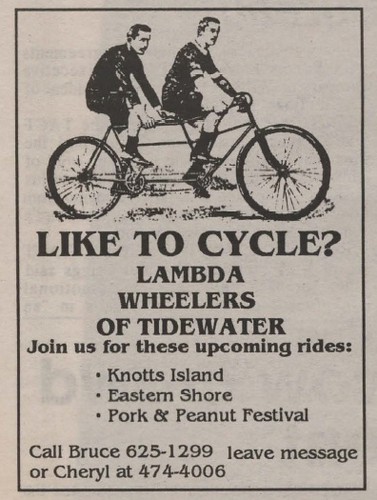
One did not need to travel far to find summer activities such as sports, recreational clubs, conferences and gatherings, festivals, or other events catering to the LGBT community.  Local LGBT sports teams, clubs, and activities included the Lambda Wheelers, an LGBT bicycling group; the Mid-Atlantic Amateur Softball Association; volleyball tournaments at Stockley Gardens and Northside Park in Norfolk; and the Mid-Atlantic Bowling League.  Other recreational activities included canoeing, hiking, rollerblading, women’s golf, and even skydiving. 

lambdawheelers-ad-july1990

Local summer benefits included pool parties sponsored by the Tidewater AIDS Crisis Taskforce (TACT) and the AIDSCARE Sunset Sprint Music Festival held at Ocean View Beach Park in June 1997.  Some LGBT folks attended the biannual Stockley Gardens Art Festival held each May. 

Local cruises on the Elizabeth River were popular.  The Mandamus Society, an LGBT social group, held an annual cruise on the Carrie-B during the 90s.  At least one year, there was an LGBT cruise on the Spirit of Norfolk too.  While “Gay Days” at Busch Gardens had not yet become a thing, the first “Gay Days” at King’s Dominion was held in July 1997.  “Gay Days” at Disney World in Florida began in the summer of 1991. 

Beach vacations were also quite popular.  Virginia Beach had its very own “Gay Beach Resort.”  The Coral Sand Motel located on Pacific Avenue catered to LGBT clientele.  The Outer Banks provided nearby beach getaways for LGBT folks.   Rehoboth Beach in Delaware was also a popular choice.  The Mandamus Society and Dignity, an LGBT Catholic group, both planned trips there in the 1990s.  Our Own contains advertisements for Rehoboth Beach Resorts.

coralsandmotel-may1992

LGBT conferences and gatherings ranged from the serious to the fun.  Many catered to diverse populations within the LGBT community.  Serious conferences included the annual Lesbian and Gay Health Conference and AIDS Forum; the Southeast Lesbian / Gay Conference in July 1991; the International Lesbian & Gay Conference in Acapulco in 1991; and a Lesbian Writer’s conference in 1992. 

Fun favorites included many women’s festivals and gatherings such as the Richmond Women’s Festival in 1990; the Roanoke Valley Women’s Festival in 1991, an annual East Coast Lesbian Festival; and WomenFest in Key West, FL in 1997.  Regular women’s festivals were held at Twin Oaks campground in Luisa, Virginia and the INTOUCH women’s campground in Kent’s Store, Virginia.  Music festivals were especially popular among Lesbians.  These festivals included the Northeast Women’s Musical Retreat; the annual Virginia Women’s Music Festival held at INTOUCH; and the annual Rhythm Fest Women’s Music, Art, and Politics Festival held at Lookout Mountain in Georgia.  Some men held camping gatherings too.  These include the annual Gay Spirit Visions Conference in Highlands, NC and a men’s gathering held at Twin Oaks in 1993.  Women’s and men’s gatherings sometimes highlighted LGBT-affirming alternative spiritual beliefs including New Age, Pagan, and Earth-based spirituality. 

Film festivals were also popular among LGBT folks.  Among these were the North Carolina Gay and Lesbian Film Festival the summer of 1997 and Outfest, an annual gay and lesbian film festival held in Los Angeles.  

Many conferences highlighted the diversity among LGBT folks – the Golden Threads Lesbian Celebration for Lesbians over age 50 in 1990; the National Gay Young Adults Conference also in 1990; a 1990 gathering of North and South American Native American LGBT folks; a 1996 conference and AIDS institute for gay men of color; and an annual “Women Celebrating Our Diversity” Gathering at Twin Oaks Campground.   Gay geeks weren’t left out as the Gaylaxicon science fiction convention, which was founded in 1988, continued throughout the 1990s and beyond. 

women-multicultural-gathering-july1991

Other big events of the 1990s included the Gay Games, an Olympic style event for LGBT athletes.  The Gay Games started in 1982 and continues to this day.  In the 1990s, the event was held in 1990, 1994, and 1998.  Many LGBT folks also attended the 1996 International Summer Olympics in Atlanta, GA.  The Atlantic States Gay Rodeo is mentioned in Our Own articles for 1996 and 1997.  Many LGBT folks attended the GALA performing arts festival held in Tampa, FL in 1996.  Maya Angelou was a keynote speaker at the event. 

The 1990s were a great time for LGBT vacation packages.  In the 1990s the travel industry took note of a perceived “disposable income” within the LGBT community.  The idea is that many LGBT professional couples have extra income that isn’t going toward raising children that they can spend on leisure instead.  While this myth persists even today, and there are many affluent people in the LGBT community, there are also many LGBT folks who aren’t especially wealthy or have dependents – LGBT parents (notably Lesbian mothers), LGBT folks from low income communities, and LGBT folks who have met with job discrimination.  During the 1990s the LGBT travel industry flourished.  Companies such as Toto Tours and Alyson Adventures offered tours, cruises, and destinations specifically for LGBT travelers.  Sometimes there were separate women’s and men’s vacations, and other times the events were mixed.  Local travel agencies such as Moore Travel (Norfolk), UNIGLOBE ITA Travel (Norfolk), and Four Seasons Travel (Williamsburg) arranged LGBT vacation packages.  Bed and breakfasts and private resorts catering to LGBT folks offered options for those looking for smaller, low-key vacations.

hotgayspots-may1993

LGBT travel magazines and guides promoted the LGBT travel industry.  Such publications included magazines like Our World and Out and About; global guides such as Damron’s many guides, Ferrari’s Places of Interest: Worldwide Gay & Lesbian Guide, and Women Going Places 1993/94: A Women’s Complete Guide to International Travel; and city specific guides like Betty & Pansy’s Severe Queer Review of San Francisco and Washington, D.C.: An Alternative Guide For Those Who Don’t Necessarily Travel the Straight and Narrow. 

So, while most of us are hoping that 2021 will be a better time than 2020 for joining in recreational activities or going on vacations, we can always look back at what folks did for fun in the 1990s.  Perhaps looking through the articles, advertisements, and event listings in Our Own will provide you with nostalgia for the days when we could go out without masks and social distancing.  Better yet, it might give you an idea for something to do when this pandemic is over. 

Archived issues of Our Own Community Press are available digitally at: https://dc.lib.odu.edu/digital/collection/ourown